




Ask a home cinema forum whether height channels should come from up-firing modules or in-ceiling speakers, and you will get a confident answer within minutes. The honest answer is less satisfying: it depends on your ceiling, not your budget. That's worth saying plainly before anything else, because most buying guides quietly skip it.
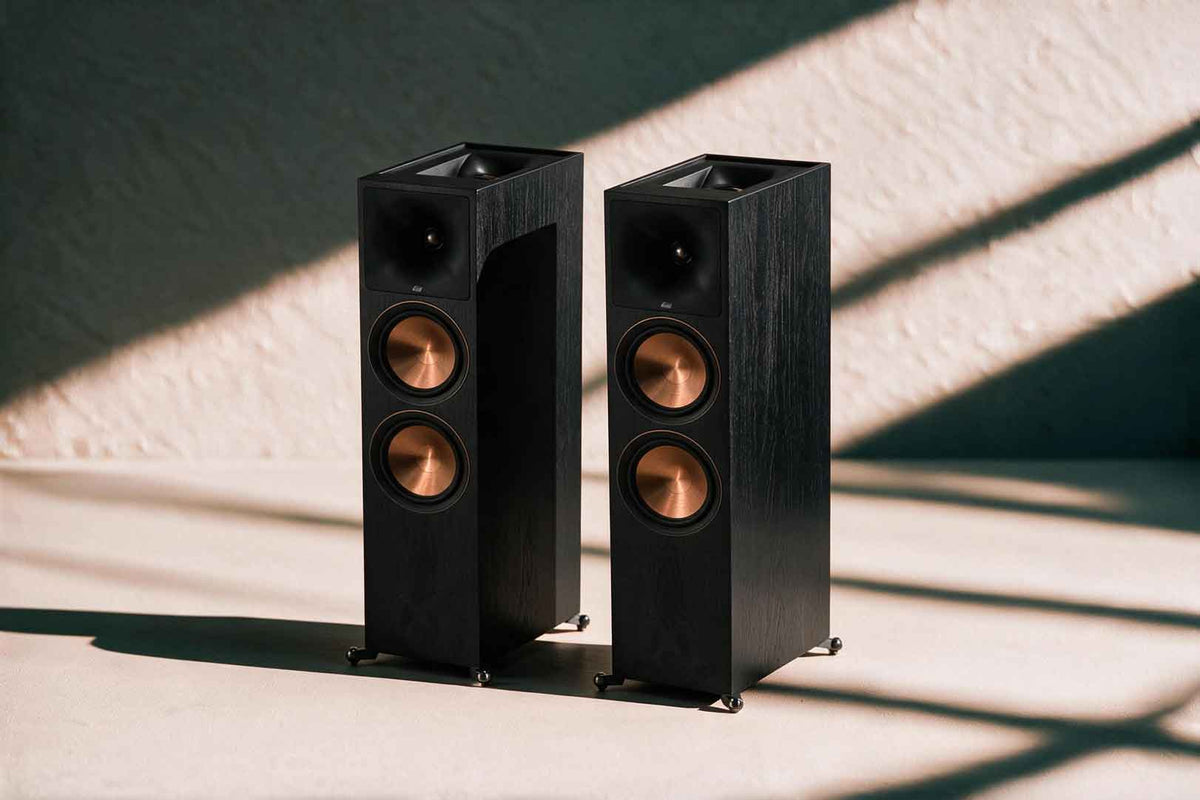
The timing for asking the question again is Klipsch's Reference Premiere III launch, announced 7 August 2026. The range puts both approaches on the same price list: the RP-8263FA is a floorstander with an integrated Atmos up-firing module built in, while the RP-5103SA is an Atmos-enabled surround speaker that does the same job from a stand-mounted position. Read together, the launch is a reminder that "which height solution" isn't a brand decision — Klipsch sells both, and so do most of its competitors. Details of the launch are on Klipsch's own announcement and covered independently by ecoustics.
What an up-firing module actually does
An up-firing Atmos speaker — whether it's a module sitting on top of a floorstander or built into the cabinet — fires sound upward at an angle so it bounces off the ceiling and arrives at the listening position from above. It's an acoustic trick, not a real overhead driver, and that means its success is entirely conditional on the ceiling behaving like a mirror for sound: flat, hard, and reasonably close to a specific range of heights above the listener.
Dolby publishes its own installation guidance for Atmos-enabled speakers and for genuine overhead (in-ceiling) speakers, including ceiling height ranges and ceiling-material requirements, and that documentation is the right starting point for anyone planning a room rather than a forum thread repeating secondhand numbers. The failure case is well understood and consistent across sources: sloped, vaulted, beamed, heavily textured, or acoustically treated ceilings (acoustic tile, exposed insulation, anything absorptive) will blunt or kill the reflection an up-firing module depends on. If your ceiling has exposed beams, a cathedral pitch, or acoustic panels already installed for other reasons, an up-firing module is fighting the room before it plays a note.
Height matters in both directions. Too low a ceiling and the reflected sound arrives too quickly to read as "above" the listener rather than just "loud." Too high, and the reflection loses level and the overhead effect becomes vague or unintelligible. There isn't a universally agreed single number worth publishing as a hard cutoff — ceiling height interacts with speaker placement, listening distance, and room dimensions — which is exactly why Dolby's documentation frames it as a range tied to specific speaker positioning rather than one figure. Anyone genuinely close to a boundary case should work from Dolby's guidance directly rather than a rule of thumb.
Checking your ceiling without instruments
You don't need test equipment to rule up-firing in or out. Stand at the main listening seat and look straight up: is the ceiling flat, hard-surfaced (plaster, drywall, painted wood) and free of beams, slopes, skylights or soft acoustic material between the speaker's firing position and your seat? If yes, up-firing modules have a reasonable chance of working as designed. If the ceiling is sloped, coffered, exposed-beam, or already carrying acoustic treatment, that's the standard failure case, and no amount of amplifier power fixes a ceiling that won't reflect cleanly.
What in-ceiling actually costs
The speaker itself is usually the smaller number. In-ceiling installation means cutting into drywall or plaster, running speaker cable through joists or a loft space, and making good the ceiling afterward — patching, sanding, repainting. None of that shows up on a spec sheet, and it's the reason in-ceiling quotes routinely surprise people who priced the job from the speaker's retail cost alone. It's also, structurally, not an option at all for a lot of households: rented properties, flats with shared ceilings, or listeners who simply don't want to open up a finished ceiling for four small holes.
For readers who can't cut into a ceiling
For renters and anyone ruling out ceiling work entirely, up-firing modules remain the only realistic route to Atmos height cues, and the room-suitability check above is the honest gate on whether they'll do anything useful. If the ceiling fails that check, the more useful answer is often not to force height channels in at all, or to accept a more modest overhead layer, rather than to spend on modules a difficult ceiling won't let work properly.
Fewer, well-placed channels versus more, compromised ones
This is where the number-of-channels question actually gets decided. A 5.1.2 setup where the two height speakers are correctly positioned for a suitable ceiling will generally deliver a cleaner, more legible overhead effect than a 5.1.4 layout where four channels are all fighting a marginal ceiling — beams, poor height, or partial treatment. Channel count is not the same as channel quality, and at a fixed budget, getting fewer height channels right is a defensible trade against forcing more channels into a room that won't reflect or accept them properly.
The interesting wrinkle in the Klipsch launch
It's worth noting, without over-reading it, that Klipsch's own showcase demo at Audio Advice Live 2026 used four Pro-180RPC in-ceiling speakers for height channels rather than up-firing modules — even as the brand's retail range, including the new RP-8263FA and RP-5103SA, leans heavily on up-firing for the products most buyers will actually install. That's not evidence that in-ceiling is categorically superior; a purpose-built demo room is built and treated specifically to make in-ceiling work, which is a very different starting point from a typical living room. But it is a reminder that the "right" answer a manufacturer chooses for its own flagship space isn't necessarily the practical answer for someone with a rental ceiling, a sloped roofline, or a budget that doesn't stretch to patching and repainting.
The bottom line the room sets, not the wallet
None of this resolves to a single verdict, because there isn't one. Up-firing modules need a flat, hard, correctly-heighted ceiling to do their job; in-ceiling speakers need a ceiling you're allowed and willing to cut into, plus a budget that accounts for installation and finishing rather than just the speaker price. The genuinely useful exercise before buying either is to look up, check what your room will actually support, and size the number of height channels to what that ceiling can deliver well — rather than to what a spec sheet suggests you should own.
Frequently asked questions
Do up-firing Atmos speakers work with a sloped or textured ceiling?
Sloped, vaulted, beamed, heavily textured, or acoustically treated ceilings are the standard failure case for up-firing Atmos modules, because the modules rely on a flat, acoustically reflective surface to bounce sound down to the listener. Absorptive or angled surfaces scatter or dampen that reflection instead of directing it, weakening or eliminating the overhead effect.
How high can a ceiling be before up-firing Atmos modules stop working?
There isn't a single universally reliable height figure, because ceiling height interacts with speaker placement, listening distance and room dimensions. Too low and the reflection arrives too quickly to register as coming from above; too high and the reflected sound loses level and clarity. Dolby's own installation documentation gives ranges tied to specific setups rather than one fixed number.
Is in-ceiling worth the installation cost compared with up-firing modules?
In-ceiling speakers require cutting into drywall or plaster, running cable through joists or loft space, and making good the ceiling afterward, costs that don't appear on a speaker's price tag but are often larger than the speaker cost itself. Whether that expense is justified depends on the room and the buyer's ability to have the work done, not on a fixed rule.
What are the options for Atmos height channels if you rent and cannot cut the ceiling?
For renters or anyone who cannot alter a ceiling, up-firing modules are the realistic route to Atmos height cues, provided the ceiling above the listening seat is flat, hard-surfaced and free of beams, slopes or soft acoustic material. If the ceiling fails that check, forcing height channels in may add less than accepting a simpler layout.
Is 5.1.4 always better than 5.1.2?
Not automatically. A 5.1.2 layout with two height channels correctly positioned for a suitable ceiling can deliver a cleaner overhead effect than a 5.1.4 layout where four channels are compromised by a marginal ceiling, such as one with beams or partial acoustic treatment. Channel count does not substitute for channel placement quality.
This article was written by an AI system from Into The HiFi AI Desk, generated from the following sources, with no human editing pass before publication: Klipsch — Klipsch Redefines Reference Premiere Series, ecoustics — Klipsch Reference Premiere III.





Leave a comment
This site is protected by hCaptcha and the hCaptcha Privacy Policy and Terms of Service apply.