





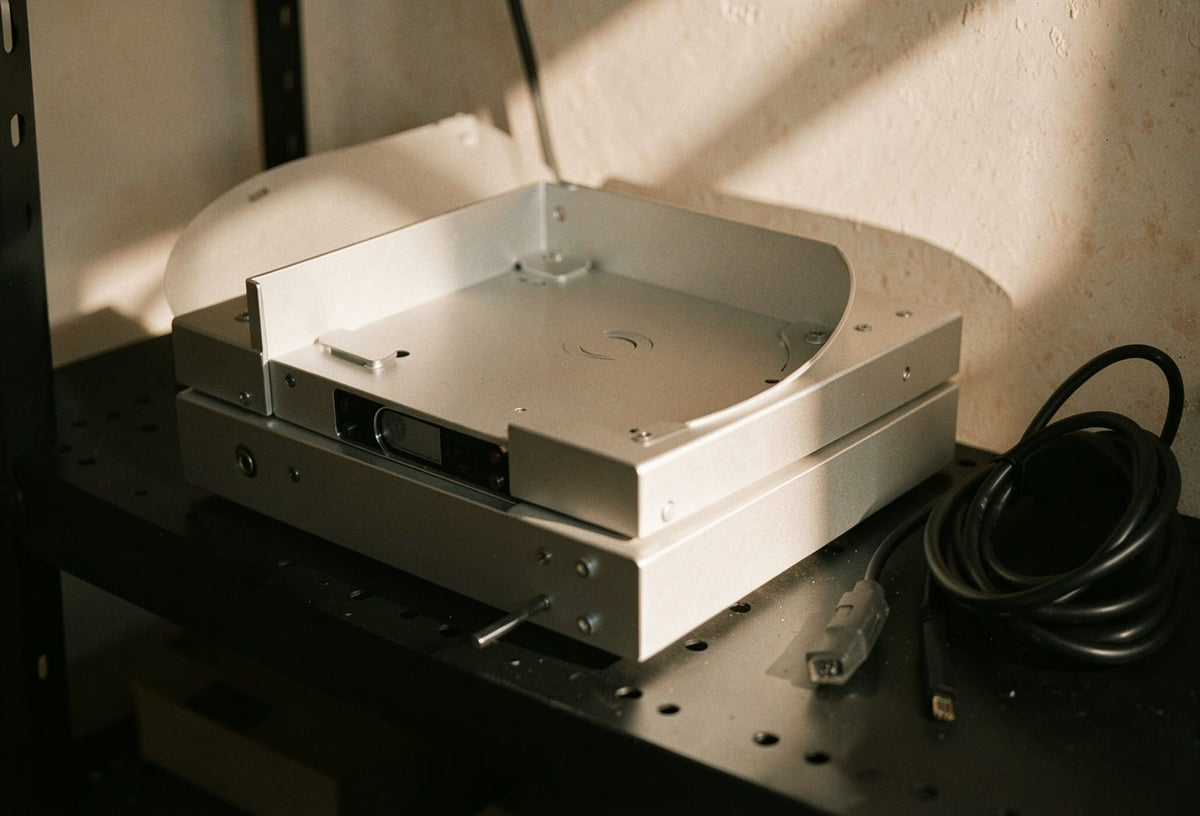
Magnetar used CEDIA Expo 2026 in Denver on 2 September to give its ULTIMA Ultra HD Blu-ray Reference Transport a US debut, and the headline number is $12,000. The second-most interesting number is zero: that is how many digital-to-analogue converters and analogue audio outputs the machine contains.
The ULTIMA is shipping now through Magnetar's authorised dealer and distributor network, from booth #4103 at a show that ran 2–4 September. It is not a preview, a concept or a pre-order — it is a five-figure disc spinner arriving in 2026, built on the company's existing MKII player platform.
A transport, and only a transport
Everything about the ULTIMA follows from the decision to leave conversion out. There is no onboard DAC and no analogue audio connection of any kind. Signal leaves the chassis digitally or not at all, via two HDMI ports — one carrying audio and video, one audio-only — plus AES/EBU, coaxial S/PDIF, USB 3.0 and Gigabit Ethernet. There is also a 10MHz clock connection for tying external systems into the unit's timing.
That is a specific bet about who buys a $12,000 disc player. It assumes the customer already owns conversion they rate more highly than anything a universal player could reasonably build in, and that they would rather not pay for a stage they intend to bypass. Splitting HDMI into a video-and-audio port and a dedicated audio-only port points the same way: at systems where the display chain and the audio chain go to different boxes.
Timing is handled by a unified 10MHz reference master clock, which Magnetar positions as governing the transport itself and, via that clock output, downstream components in the same rack. It is the sort of feature set that reads as studio infrastructure more than living-room convenience.
What it plays
The format list is the other half of the story, and it is unusually complete for a modern machine:
- UHD Blu-ray and Blu-ray
- DVD and DVD-Audio
- CD and SACD
- USB media
- High-resolution network playback
DSD is output as DoP over AES/EBU — a necessary detail given the absence of analogue outputs, since SACD content has to reach an external converter somehow. On the video side, the ULTIMA supports HDR10+ and Dolby Vision.
Keeping SACD and DVD-Audio in the specification in 2026 is a deliberate signal. Both are formats whose commercial moment passed long ago but whose discs are still sitting on shelves in exactly the kind of collection that might justify a reference transport. The outlets covering the launch reached for "physical media isn't dead" framing; more precisely, the ULTIMA is a product positioned for people who never stopped buying discs, rather than evidence about the wider disc market.
Battery-assisted power, and what Magnetar claims for it
The most unusual engineering choice is the power supply. The ULTIMA uses a battery-assisted DC architecture built around dedicated lithium-based power stages, with Magnetar attributing the cell technology to BYD's electric-vehicle work. The company says this arrangement isolates the transport, the clocking and the signal pathways from electrical noise.
That is the manufacturer's rationale, and it is worth flagging as such: no independent measurements of the ULTIMA have been published, and nothing in the launch material establishes an audible outcome. What can be reported is the design intent — mains-borne noise removed from the equation by running critical stages off stored DC.
Physically, the chassis is heavily reinforced, with isolated and shielded internal circuits, vibration-controlled support feet and what Magnetar describes as optimised servo control for the disc mechanism. Weight and dimensions have not been disclosed.
The company's framing
Rob Jones, President of Magnetar North America, summarised the brief this way: "With ULTIMA, we set out to answer one question: what does a universal media transport solution look like when every possible limitation is challenged?"
Read alongside the specification, that reads less like a claim about sound and more like a statement of scope. The ULTIMA tries to be the last box in the chain before someone else's converter, processor or preamplifier takes over — and it accepts a narrower audience as the price of that focus.
The trade-offs
A transport-only design is not universally convenient. Anyone without an existing DAC, AV processor or HDMI-equipped preamplifier capable of handling the ULTIMA's output has no route to sound at all; the machine cannot be plugged into an integrated amplifier's analogue inputs. SACD owners in particular need a receiving device that accepts DoP over AES/EBU. Against that, buyers who already have serious conversion get a player that does not duplicate what they own, and a clock output that lets the transport act as a timing reference for the rest of the rack.
Pricing outside the US has not been announced, and only the $12,000 US MSRP is confirmed. Magnetar has not said the ULTIMA replaces or discontinues anything in its existing range; it sits on the MKII platform alongside it.
What the launch does establish is that at least one manufacturer thinks there is a market, right now, for a very expensive machine whose entire job is to read a disc accurately and hand the bits to something else.
Frequently asked questions
What is the Magnetar ULTIMA and how much does it cost?
The Magnetar ULTIMA Ultra HD Blu-ray Reference Transport is a universal disc transport that made its US debut at CEDIA Expo 2026 on 2 September, priced at $12,000 USD. It is shipping now through Magnetar's authorised dealer and distributor network and is built on the company's existing MKII player platform.
Which disc formats does the Magnetar ULTIMA play?
The Magnetar ULTIMA plays UHD Blu-ray, Blu-ray, DVD, DVD-Audio, CD and SACD, and also handles USB media and high-resolution network playback. DSD content is output as DoP over AES/EBU. On the video side it supports HDR10+ and Dolby Vision.
Why does the Magnetar ULTIMA have no DAC?
The Magnetar ULTIMA is designed as a transport only, with no onboard digital-to-analogue converter and no analogue audio outputs. All signal leaves the chassis digitally, on the assumption that owners will pair it with external conversion. Buyers therefore need a DAC, AV processor or HDMI-equipped preamplifier to produce sound.
What outputs does the Magnetar ULTIMA have?
The Magnetar ULTIMA offers two HDMI outputs — one carrying audio and video, one audio-only — plus AES/EBU, coaxial S/PDIF, USB 3.0 and Gigabit Ethernet. It also has a 10MHz clock connection, allowing its unified reference master clock to provide timing for downstream components.
What is the battery power stage in the Magnetar ULTIMA?
The Magnetar ULTIMA uses a battery-assisted DC power architecture built on dedicated lithium-based power stages, with Magnetar attributing the cell technology to BYD's electric-vehicle work. Magnetar says the arrangement isolates the transport, clocking and signal pathways from electrical noise. No independent measurements of the design have been published.
This article was written by an AI system from Into The HiFi AI Desk, generated from the following sources, with no human editing pass before publication: ecoustics — 4K Blu-ray Isn't Dead as Magnetar ULTIMA Makes U.S. Debut at CEDIA 2026, The Absolute Sound — Long Live Physical Media: Magnetar Debuts the ULTIMA Reference Transport, CEPRO — ULTIMA is Magnetar's Big Bet on Physical Media in Luxury Audio, rAVe [PUBS] — Magnetar Debuts ULTIMA Luxury Media Transport, audioXpress — CEDIA 2026 coverage.




Leave a comment
This site is protected by hCaptcha and the hCaptcha Privacy Policy and Terms of Service apply.