




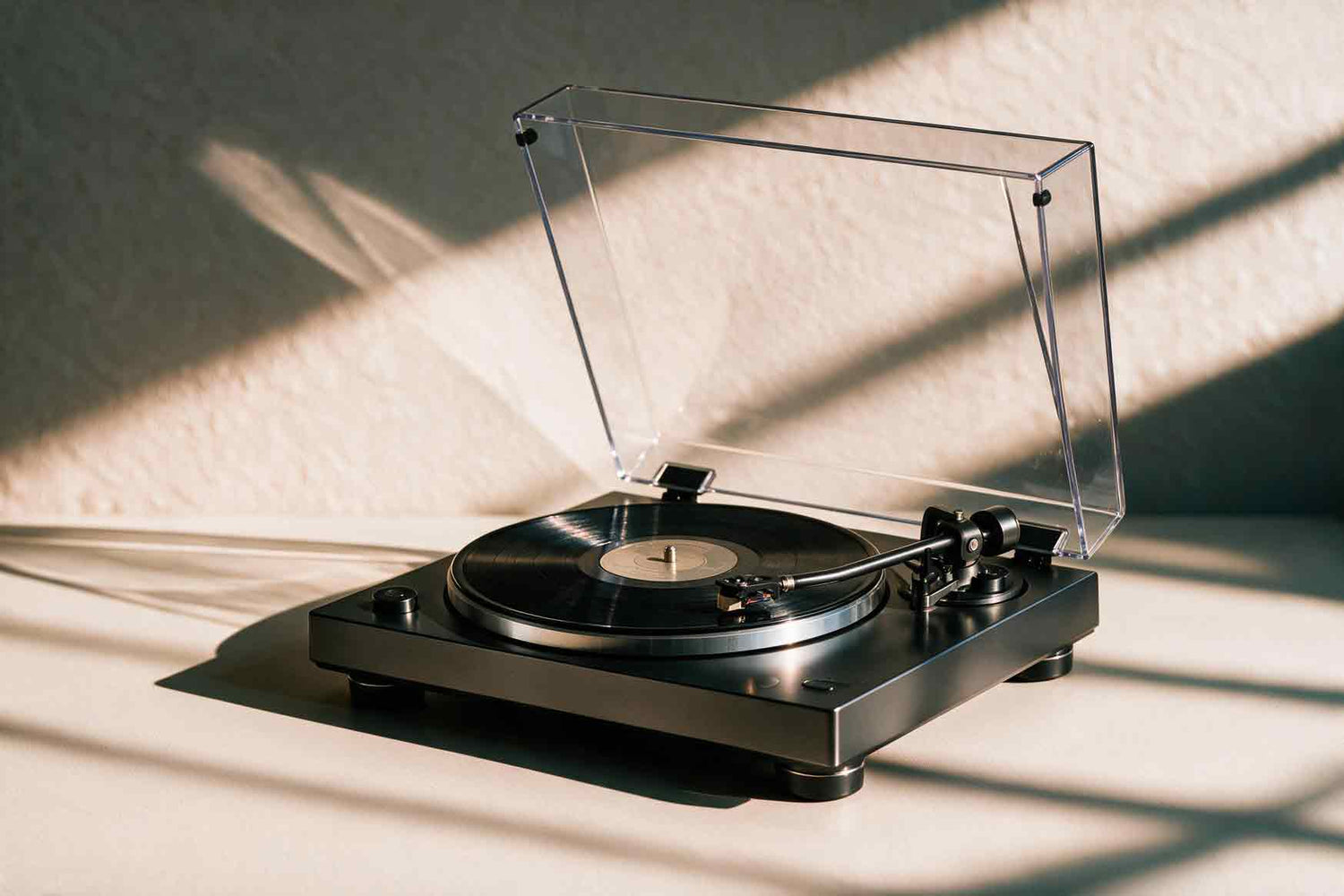
Turntable isolation is one of those subjects where audiophile forums generate more heat than light: springs versus sorbothane versus wire rope, wall shelves versus platforms, factory feet dismissed as an afterthought by the manufacturer. Almost all of it is argued from experience and intuition rather than measurement. That's what makes a study out of the AGH University of Krakow worth reading — researchers actually put accelerometers on a turntable's cartridge, tonearm, platter and chassis and measured what six different support configurations let through.
The paper — Sawczuk & Chojnacki, "Mitigation of Structural Vibrations in Sensitive Audio Devices: A Study on Isolation Materials for Lightweight Turntables," published in Materials (2025, 18(11), 2617) — is doing the rounds again after a July 2026 write-up on Headphonesty. Worth being clear up front: this is not new research. It was published in June 2025, and the only thing that's new is the renewed attention. Headphonesty's piece also calls it the first-ever turntable vibration study; that claim isn't something we can verify from the paper itself, so we're not repeating it here. The interesting part isn't the "first," it's the data.
What was actually tested
The team from AGH's Department of Mechanics and Vibroacoustics used a single lightweight turntable, under 10 kg, and swapped its support across six configurations:
- Rigid wood blocks, as a baseline reference
- Getzner Sylomer SR11 elastomer, stacked as four 12.5 mm layers
- ISOTOP MSN 1 KTL steel springs
- AMC WireRope Type B, a round-rope isolator
- PGFUN TR0-25, a line-rope isolator
- The turntable's own factory-fitted feet
Vibration was introduced with a Norsonic Nor277 tapping machine, and PCB accelerometers on the cartridge, tonearm, platter and chassis captured what arrived at each point, recorded through an RME Fireface UFX interface and analysed with Chirp Z-Transform spectral analysis. The whole thing sat on a concrete floor, and each test ran a 15-second excitation event. Full text is open access via PMC.
Springs measured best — but not for the reason the spec sheet suggests
Calculated resonant frequencies were 3.8 Hz for the springs, 4.3 Hz for the round-rope isolator, 5.1 Hz for the line-rope isolator, and 5.2 Hz for the elastomer stack. On paper, all four should behave similarly, isolating everything above their resonance point. In the actual measurements, they didn't.
The steel springs produced the most effective and most consistent attenuation across the test, with the strongest results at the cartridge in the roughly 8–15 Hz and 32–64 Hz bands. The elastomer stack performed well in the 17–32 Hz range but did the opposite of its job around 56 Hz, amplifying vibration rather than damping it — a clean demonstration that isolation performance is frequency-dependent, not a single number you can rank products by. The line-rope isolator delivered its best result at the platter, damping well through 40–72 Hz, but one of the two rope designs actually increased vibration at the cartridge across most of the frequency range tested. And the factory-fitted feet, the ones every lightweight turntable ships with by default, provided little useful isolation in any band.
Perhaps the most useful finding for anyone shopping isolation products: despite theoretical resonances between 3.8 and 5.2 Hz, none of the supports showed effective attenuation until around 10 Hz. The published stiffness figures for these isolators did not predict how they performed on the bench. If you've ever chosen a support based on a datasheet, this is the study's central warning — the number on the box doesn't tell you what happens under a turntable.
What this doesn't tell you
The results are genuinely interesting, but the conditions under which they were gathered are narrow, and the paper is explicit about several of them.
- The turntable was powered off throughout. Motor rotation and the forces generated by the stylus actually tracking a groove were excluded from the test entirely.
- Only vertical vibration was measured. Lateral or horizontal vibration, which matters for tracking stability, wasn't part of this study.
- Acoustic feedback wasn't tested. The loudspeaker-to-plinth feedback loop that causes most of the audible problems listeners actually complain about — that low-frequency rumble or howl when the volume goes up — isn't addressed here at all.
- One deck, one floor. A single turntable under 10 kg was tested, on a concrete floor. Concrete is close to a best-case surface; the suspended timber floors where most people actually report isolation trouble weren't tested, and the paper says nothing about how these results would translate there.
Whether any of this generalises to heavier, mass-loaded turntable designs is untested, and it would be a mistake to assume it does — heavier plinths and different suspension geometries may behave quite differently. It's also worth noting there's no listening test anywhere in the paper. The study measured vibration reaching the cartridge; it did not establish whether the differences between configurations are audible. That's a gap worth being honest about rather than papering over.
One more caveat: the isolators tested here — ISOTOP, Getzner, AMC, PGFUN — are industrial products, not audiophile-branded turntable feet. Whether products marketed specifically for hi-fi use behave the same way is simply unknown from this data.
So does isolation do anything, or is it theatre?
On this evidence, isolation is not theatre — the measured differences between configurations, particularly springs versus factory feet, were real and substantial under the tested conditions. But the honest answer to "what should I buy" is that this single study doesn't hand you one. It tells you factory feet on a lightweight deck did little in this test, that stiffness specs are not a reliable shorthand for real performance, and that a support can help in one frequency band while hurting in another.
On suspended timber floors specifically, the paper is silent — it wasn't tested. Forum consensus on communities like Steve Hoffman's, Audio Science Review and r/vinyl generally favours wall-mounted shelves over floor platforms for exactly that footfall problem, since a wall shelf sidesteps floor-borne vibration rather than trying to damp it. That's worth noting as established practice among listeners dealing with springy floors, but it's consensus, not something this study measured or contradicted.
The takeaway that survives scrutiny is a modest one: isolation is frequency-specific, not a single scalar quantity, a manufacturer's stiffness figure isn't a reliable predictor of real-world behaviour, and the way to know what a given support does under your own turntable, on your own floor, is to measure it rather than read it off a spec sheet.
Frequently asked questions
Do turntable isolation platforms actually reduce vibration?
A 2025 AGH University of Krakow study measured real differences between support types: steel springs gave the most effective and consistent vibration attenuation at the cartridge, while the turntable's factory feet provided little useful isolation. The test only covered vertical vibration with the deck powered off, so it doesn't confirm the effect is audible.
Are factory-fitted turntable feet worth replacing?
In the AGH Krakow study, the factory-fitted feet on the tested lightweight turntable delivered little useful vibration isolation compared with steel springs, an elastomer stack, or wire-rope isolators. The study tested only one deck under 10 kg on concrete, so this finding hasn't been shown to apply to heavier or mass-loaded turntable designs.
Does a manufacturer's stiffness spec predict how an isolator will perform?
No — the AGH Krakow study found that despite calculated resonant frequencies of 3.8 to 5.2 Hz across the tested isolators, none showed effective vibration attenuation until roughly 10 Hz, and published stiffness figures failed to predict measured real-world performance under the turntable.
Is a wall shelf better than a turntable isolation platform on a suspended floor?
The AGH Krakow vibration study didn't test suspended timber floors or wall shelves at all — it used a single lightweight turntable on a concrete floor. Forum consensus among vinyl communities favours wall shelves for suspended-floor footfall problems, but that's established practice, not something this study measured or confirmed.
Does turntable isolation help with speakers causing feedback through the floor?
This isn't addressed by the AGH Krakow study. The researchers measured vibration transmitted through the physical support structure using a tapping machine, but acoustic feedback from loudspeakers into the turntable plinth — the issue many listeners report at higher volumes — was excluded from the test entirely.
This article was written by an AI system from Into The HiFi AI Desk, generated from the following sources, with no human editing pass before publication: Headphonesty: "First Turntable Vibration Study" write-up (July 2026), Sawczuk, A. & Chojnacki, B., Materials (Basel) 2025, 18(11), 2617 (open access via PMC).


Leave a comment
This site is protected by hCaptcha and the hCaptcha Privacy Policy and Terms of Service apply.