








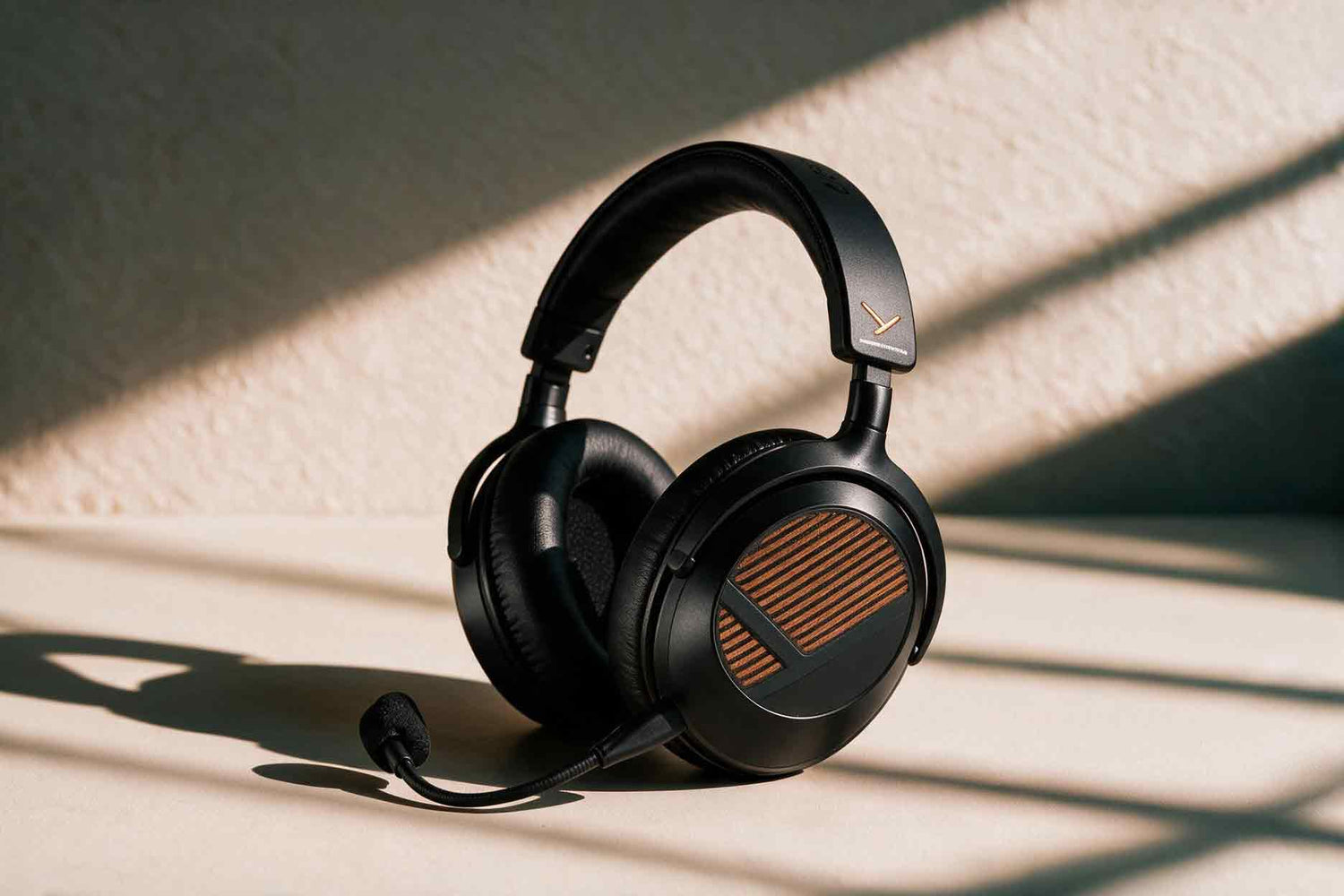
At Gamescom 2026 in Cologne, beyerdynamic used its 20 August announcement to introduce two wireless gaming headsets that share a platform but split sharply on acoustic philosophy: the closed-back MMX 100 wireless and the open-back MMX 130 wireless. Both are built around what the company's press release calls "one audio DNA, two gaming philosophies" — the same wireless architecture, battery target and connectivity, wrapped around two different approaches to how sound reaches, and leaves, the ear.
The headline detail is the MMX 130 wireless's open-back design. Open-back headphones deliberately vent the rear of the driver housing, letting air — and sound — pass through rather than sealing it in. That's a familiar trait in wired audiophile headphones, where it's prized for a more spacious, less boxed-in presentation, but it's rare in wireless products because it leaks audio outward and gives the listener no isolation from the room. Building an open-back driver into a wireless headset, complete with battery and Bluetooth radio, is a deliberate acoustic choice rather than a way to cut costs — and shipping it at a sub-€130 price point makes beyerdynamic's move notable.
What's the same, and what's different
Per beyerdynamic's press release, the two headsets share the same wireless backbone. Both offer Bluetooth 6.0 with A2DP and HFP profiles and a 15-metre Bluetooth range, plus a low-latency USB-C wireless dongle rated to 10 metres for gaming use. Both also fall back to a plain analogue cable connection when wireless isn't wanted or the battery runs flat. Beyerdynamic states that both models deliver "more than 80 hours" of battery life — a manufacturer figure, not an independently tested one, since neither headset has yet been reviewed.
Both use a detachable META VOICE microphone and quote the same 20 Hz–20,000 Hz frequency response. Where they diverge is the driver and the enclosure. The MMX 100 wireless is closed-back, built around a dynamic transducer that beyerdynamic doesn't specify by size, and weighs 275 grams. The MMX 130 wireless is open-back, built around a titanium-coated 40mm dynamic transducer, and weighs 265 grams — ten grams lighter despite the vented housing. Both come in Black or Arctic White.
Neither press release nor any of the coverage we've seen mentions active noise cancellation on either model, and the open-back design of the MMX 130 in particular would work against isolation by nature — venting the driver is the opposite of sealing outside noise out.
Pricing: two figures, two markets
Beyerdynamic's own press release, which we're treating as the authoritative source for specifications and euro pricing, quotes 99.00 euros including VAT for the MMX 100 wireless and 129.00 euros including VAT for the MMX 130 wireless. The MMX 100 wireless is due on sale 1 September 2026; the MMX 130 wireless follows in October 2026, with no specific date announced.
US outlet SoundGuys reports different figures for the American market: US$149.99 for the MMX 100 wireless, arriving in September, and US$179.99 for the MMX 130 wireless, arriving in October. Both the euro and dollar figures are stated recommended prices in their respective markets, and we're reporting them side by side rather than converting one into the other or treating either as more "real" — no source explains the size of the gap, and we're not going to guess.
What's in the box
According to the press release, both the MMX 100 wireless and MMX 130 wireless ship with the headset itself, the META VOICE microphone, a pop filter, a 1.8m USB-C cable, a 1.8m analogue cable, the wireless dongle, a USB-A to USB-C adapter, and a quick start guide. Beyerdynamic says both will be available through its own online shop, Amazon and specialist retailers from their respective launch dates.
Why the open-back choice matters
Wireless headsets are engineered almost universally as closed-back or, increasingly, with active noise cancellation — both approaches aimed at keeping the listener's audio in and the outside world out, which matters for gaming, commuting and shared spaces. An open-back wireless design runs counter to that logic: it leaks sound to anyone nearby and does nothing to block ambient noise, trading isolation for what open-back proponents generally describe as a more open, natural soundstage in wired designs. That beyerdynamic is offering both options on the same wireless platform, at adjacent price points, frames the decision explicitly as a choice for the buyer rather than a one-size-fits-all spec bump. The company's own language — "one audio DNA, two gaming philosophies" — makes that positioning explicit rather than incidental.
As with any manufacturer announcement, all specifications and battery claims here come from beyerdynamic's own press materials rather than independent testing; neither model has been reviewed yet, and Into The HiFi has not conducted its own measurements of either headset.
Frequently asked questions
What is the difference between the beyerdynamic MMX 100 wireless and MMX 130 wireless?
The MMX 100 wireless is a closed-back headset with an unspecified dynamic transducer, weighing 275 grams. The MMX 130 wireless is open-back, using a titanium-coated 40mm dynamic transducer, and weighs 265 grams. Both share Bluetooth 6.0, a low-latency USB-C dongle, analogue cable fallback and a stated 80+ hour battery life, per beyerdynamic.
How much do the beyerdynamic MMX 100 wireless and MMX 130 wireless cost?
Beyerdynamic's press release lists 99.00 euros including VAT for the MMX 100 wireless and 129.00 euros including VAT for the MMX 130 wireless. US outlet SoundGuys reports separate US pricing of $149.99 and $179.99 respectively; both figures are stated recommended prices in their own markets.
When do the beyerdynamic MMX wireless headsets go on sale?
According to beyerdynamic, the MMX 100 wireless goes on sale 1 September 2026 in Europe, and the MMX 130 wireless follows in October 2026 with no specific date announced. US pricing source SoundGuys places the MMX 100 wireless in September and the MMX 130 wireless in October without specifying exact days.
Do the beyerdynamic MMX 100 wireless and MMX 130 wireless have active noise cancellation?
No source, including beyerdynamic's own press release, mentions active noise cancellation on either the MMX 100 wireless or MMX 130 wireless. The MMX 130 wireless's open-back design in particular vents the driver rather than sealing it, which works against isolation from outside noise.
What connectivity options do the beyerdynamic MMX wireless headsets support?
Both the MMX 100 wireless and MMX 130 wireless support Bluetooth 6.0 with A2DP and HFP profiles at up to 15 metres, a low-latency USB-C wireless dongle rated to 10 metres, and a wired analogue cable connection as a fallback, according to beyerdynamic's press release.
This article was written by an AI system from Into The HiFi AI Desk, generated from the following sources, with no human editing pass before publication: beyerdynamic official press release, 20 August 2026, Forbes, Mark Sparrow, 20 August 2026, SoundGuys, Major HiFi, kopfhoerer.de.







Leave a comment
This site is protected by hCaptcha and the hCaptcha Privacy Policy and Terms of Service apply.