





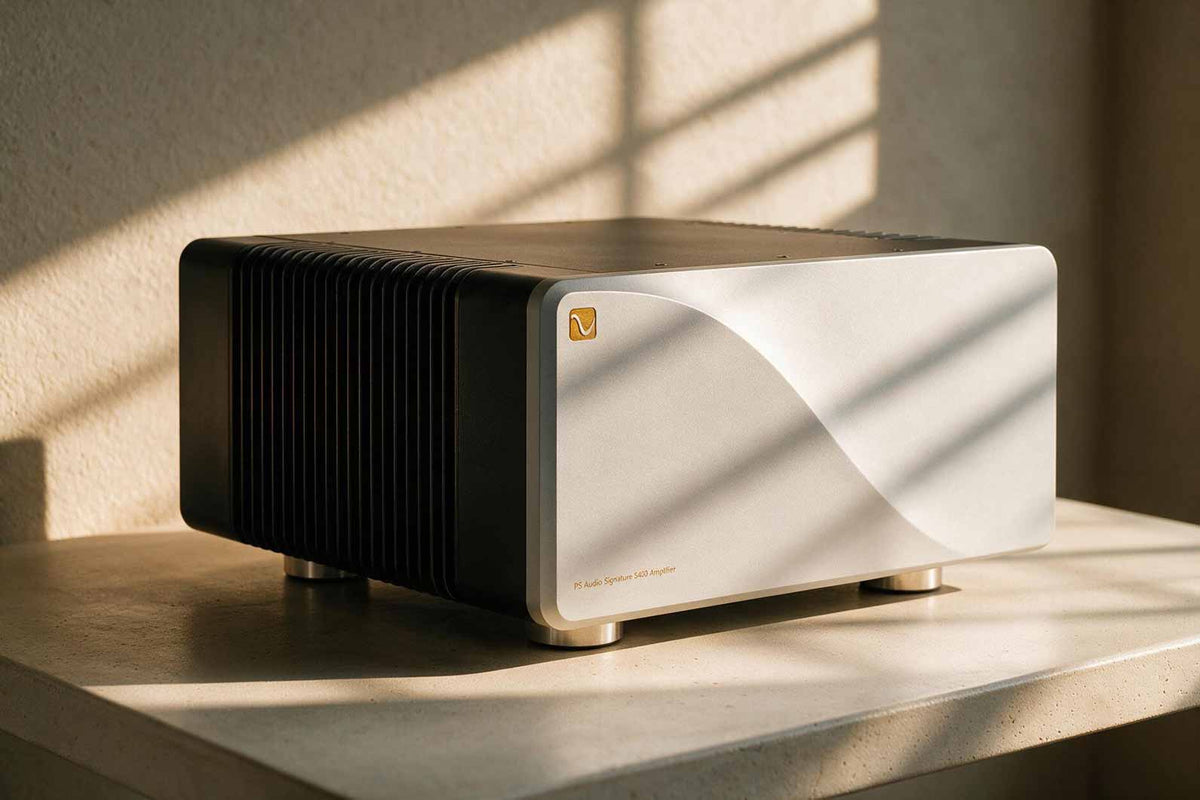
PS Audio has begun shipping the first two amplifiers in its new Paul McGowan Signature (PMG) Series: the 400-watt S400 at $9,999 and the 200-watt S200 at $7,999. Announced 24 July 2026 and confirmed as shipping days later, the pair represents the Colorado-based company's most technically assertive stereo power amplifiers to date, sitting above the existing Stellar and Radia lines in PS Audio's catalog.
The headline engineering claim is one most buyers will never have encountered on a spec sheet: neither amplifier uses a conventional mains transformer. Instead, both rely on what PS Audio calls an "active" power supply architecture. In a traditional power amp, a large transformer converts wall voltage into the DC rails that feed the output stage, and that transformer's size, regulation, and transient behavior have an outsized effect on how the amp responds to sudden demands from the music. An active supply replaces that passive, one-size-fits-all component with a supply that's part of the amplifier's active circuit design — in principle allowing tighter regulation and a faster, more controlled response to the amp's own current demands, rather than leaving that job to a hunk of iron and copper reacting passively to line voltage. It's a genuinely unusual choice for a full-sized home power amplifier, and it's the thing that separates the PMG series conceptually from PS Audio's other lines.
Class A, but not where you'd expect it
Both amplifiers bias their output stages into pure Class A operation for an initial window of power, then transition to Class AB beyond that. What's notable is the direction of the numbers: the smaller S200 runs its first 10 watts in pure Class A, while the larger, more powerful S400 runs only its first 5 watts in pure Class A. That's an inversion of what some might assume — the higher-power amplifier does not get the wider Class A window. Both The Absolute Sound and Hifi Pig report the figures this way, so it appears to be a deliberate design tradeoff rather than an error: the S200, built around lower total output, can afford to keep more of its usable power in the linear, low-distortion Class A region, while the S400 prioritizes headroom and current delivery at the expense of a smaller Class A slice.
Rated output is 400 watts into 4 ohms for the S400 and 200 watts into 4 ohms for the S200. Neither manufacturer nor either review outlet published 8-ohm figures for this series, so no 8-ohm number should be assumed or compared against other amps' 8-ohm specs.
Beyond the power supply and bias scheme, both amplifiers share a very low negative feedback topology, with bandwidth specified as extending beyond 500kHz and slew rate quoted as exceeding 200V per microsecond — numbers meant to signal a fast, wide-open circuit with minimal correction being applied after the fact. The series was designed by Darren Myers and engineered by PS Audio's Bob Stadherr, and carries the initials of company co-founder Paul McGowan, for whom it's named.
Room-integration features, not just spec-sheet flourishes
What keeps the S400 and S200 from being pure lab-bench exercises is a set of practical connections aimed at real systems. Both amps offer balanced XLR and single-ended RCA inputs, dual pairs of speaker outputs for bi-wiring, a 12V trigger input for integration with a broader system, and — notably for amplifiers pitched at this level of purism — dedicated left and right subwoofer outputs.
Subwoofer outputs on a two-channel power amplifier are worth dwelling on, because they're not a common inclusion at this end of the market. Many buyers who reach for a $8,000–$10,000 stereo power amp are running a two-channel system that still wants low-frequency reinforcement, whether for movies, vinyl, or simply extending bass response without disturbing the main speakers' voicing. Built-in sub outputs mean that integration doesn't require an external line-level splitter, a preamp with its own sub-out, or extra boxes cluttering the rack. It's a small feature on paper, but it answers a real-world question a lot of two-channel listeners run into once they own serious speakers and want more bottom end without changing the character of the top end.
Two sizes, one footprint
The choice between the S400 and S200 isn't really about fitting one or the other into a rack. Physically, they're nearly identical: the S400 weighs 57.2 lbs and the S200 weighs 56.2 lbs, and both share the same 16.75-inch depth, 17.5-inch width, and 8.75-inch height. Both are available in black or silver finishes. In other words, the decision between the two models comes down to how much power a given room and speaker pairing needs, and how much of that power a listener wants delivered in pure Class A, not which one will fit on a shelf.
Pricing for the UK and EU markets has not yet been announced. No listening review has been published for either amplifier at this point — what's confirmed so far is the announcement and the start of shipping, not any assessment of how they sound in a room. For now, the S400 and S200 stand as a clear statement of intent from PS Audio: an active power supply, an inverted Class A bias scheme between the two models, and connectivity built for listeners who want to slot a serious amplifier into an existing two-channel system rather than rebuild around it.
This article was written by an AI system from Into The HiFi AI Desk, generated from the following sources, with no human editing pass before publication: The Absolute Sound: PS Audio Now Shipping Its PMG Signature Series S400 and S200 Stereo Power Amplifiers, Hifi Pig: PS Audio PMG Signature Series S400 And S200 Stereo Power Amplifiers, PS Audio PMG S400 product page, PS Audio PMG S200 product page, PS Audio Paul McGowan Signature Series collection page.




Leave a comment
This site is protected by hCaptcha and the hCaptcha Privacy Policy and Terms of Service apply.