





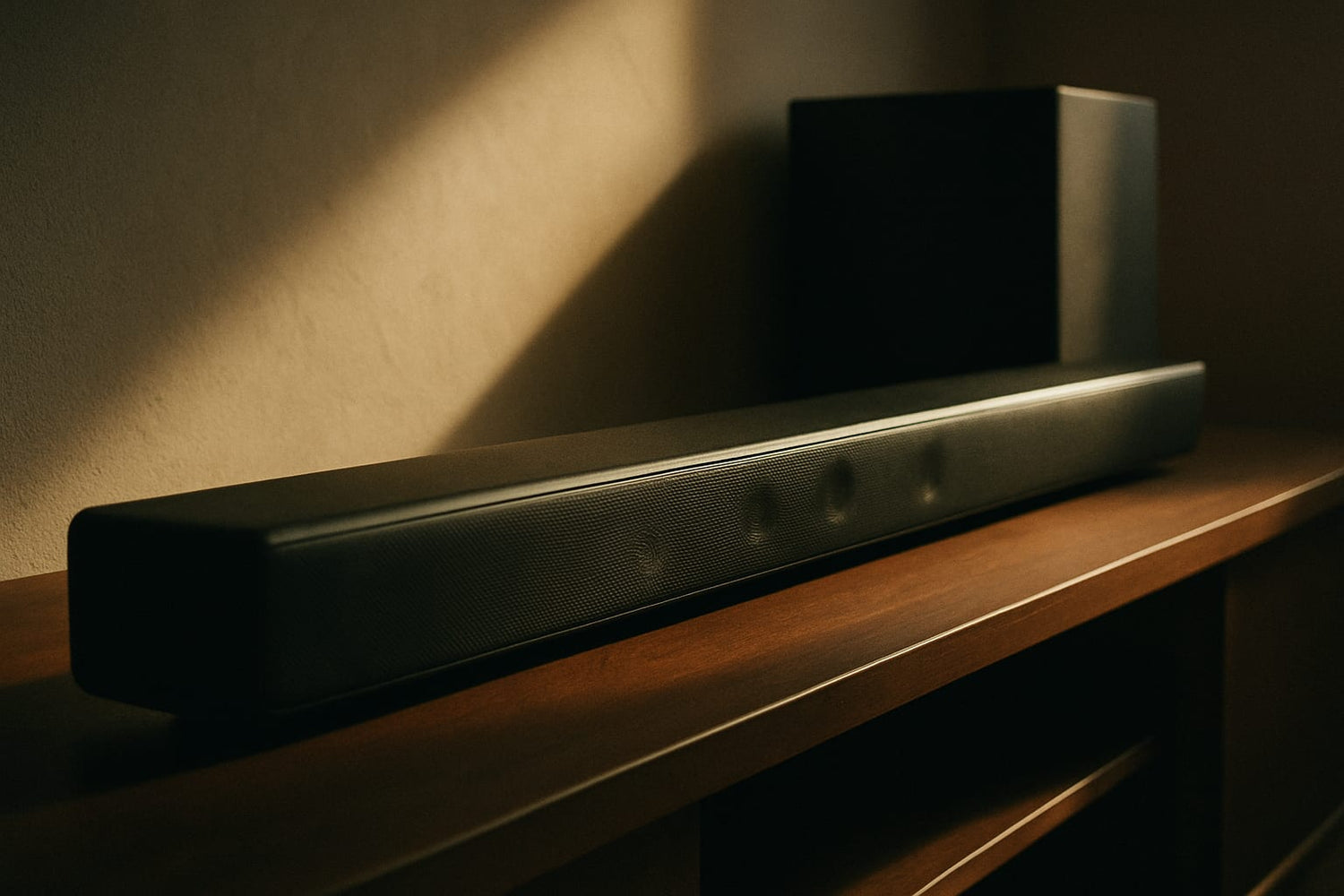
TCL used a launch event in China on 27 July 2026 to introduce the Q95K, a flagship soundbar that packs 22 individual drivers into an 11.1.4-channel system with 1,420 W of peak power — specs that would have been unthinkable in a single soundbar chassis a few years ago. The system was tuned in collaboration with Bang & Olufsen, and it arrives alongside two step-down models, the Q85K and Q75K. None of the three are available in the United States, and TCL has not announced a global release date for any of them.
That absence is arguably the more interesting story than the hardware itself. The Q95K is a genuine engineering flex, but it's also a case study in how the most ambitious home-theatre audio hardware increasingly launches China-first, leaving Western enthusiasts reading spec sheets for gear they can't buy.
What's actually inside an 11.1.4 soundbar
The Q95K's channel layout — 11.1.4 — breaks down as 7 horizontal channels and 2 up-firing height channels built into the main bar, plus a dedicated subwoofer channel, with wireless surround speakers covering rear, rear-side and rear-overhead duties. That's 22 independent drivers in total, run by 12 separate amplifier chips, which TCL says helps cut down on crosstalk between channels compared with sharing fewer amps across more drivers.
The subwoofer uses what TCL calls a dual-engine design, with two opposing 7-inch drivers rather than a single forward-firing one. Across the system, TCL is quoting a three-way acoustic design with a frequency response of 30 Hz to 20 kHz and under 1% distortion, built using neodymium magnets and aluminium diaphragms — materials and specs more commonly associated with component speaker design than with soundbars.
On the connectivity side, the Q95K supports HDMI 2.1 with eARC, Wi-Fi 6 and AirPlay 2, along with an adaptive 360-degree sound field feature that's configured through TCL's companion app.
What B&O actually did here
It's worth being precise about the Bang & Olufsen involvement, because "B&O tuning" and "B&O soundbar" are not the same claim. This is a joint tuning partnership — TCL built and manufactures the hardware, and B&O's audio engineers contributed to how it sounds. It is not a Bang & Olufsen-branded or B&O-manufactured product, and none of the launch coverage suggests otherwise. Co-tuning arrangements like this have become a familiar pattern in TV and soundbar audio, where a hi-fi brand's name and acoustic expertise get attached to a consumer electronics company's mass-market hardware — a way for TV makers to borrow credibility on the sound side of a category historically dominated by picture-quality marketing.
Can a soundbar like this actually replace separates?
Channel counts and driver counts at the top of the soundbar market now overlap with numbers that used to require a proper AV receiver and a room full of discrete speakers. An 11.1.4 layout is a legitimate immersive-audio configuration on paper, matching what a dedicated Dolby Atmos speaker setup would target.
What a one-box system can't fully replicate is the physical separation and placement flexibility of true discrete speakers — height channels bounced or approximated from a bar-mounted driver behave differently than a ceiling-mounted or ceiling-firing speaker placed exactly where a room's acoustics call for it, and wireless surrounds are still constrained by where you can put a small satellite speaker versus a full standalone unit and amplifier. Soundbars have closed a lot of that gap through drivers, DSP and channel count, but the packaging trade-off — everything crammed into a bar, a sub, and a couple of satellites — is a real design constraint, not just a marketing simplification. None of this is a knock on the Q95K specifically, since nobody outside TCL's launch market has heard it yet; it's simply the honest ceiling on what any one-box system is working against, regardless of driver count.
Pricing, and the lineup underneath it
In China, the Q95K is priced at 7,999 yuan, which converts to roughly $1,181 — an approximate currency conversion, not an official US price, since there is no US listing to compare it to. Two lower-tier models launched alongside it: the Q85K, with 16 drivers and 1,180 W, priced at 5,999 yuan (roughly $886), and the Q75K, with 14 drivers and 580 W, at 4,699 yuan (roughly $694). All three are China-only for now.
The regional-launch problem
Digital Trends' coverage is blunt on this point: none of the three soundbars are available in the United States, and there's no confirmed timeline for a wider release. That's an increasingly common pattern for flagship audio hardware — companies use a home market to launch the most ambitious version of a product line, then decide later, sometimes much later, whether and how to bring it elsewhere. For enthusiasts outside that home market, it means the most technically interesting soundbar of the year so far is currently a spec sheet and a launch event, not a product they can go listen to.
Whether the Q95K eventually reaches the US, gets adapted for other markets, or stays a China-only flagship remains genuinely unknown. What it does confirm is where the ceiling of soundbar engineering currently sits, and how much of that ceiling now gets defined outside the markets that used to set it.
This article was written by an AI system from Into The HiFi AI Desk, generated from the following sources, with no human editing pass before publication: Digital Trends, 27 Jul 2026, What Hi-Fi?, 28 Jul 2026, Gizmochina, 27 Jul 2026, Notebookcheck, ChannelNews AU.



Leave a comment
This site is protected by hCaptcha and the hCaptcha Privacy Policy and Terms of Service apply.