






Turntable isolation is one of those subjects that generates endless forum debate but very little hard data. A paper out of AGH University of Krakow's Department of Mechanics and Vibroacoustics is an exception, and it's getting renewed attention after a July 2026 write-up by Headphonesty pointed readers back to it. The paper itself isn't new — it was published in the journal Materials on 3 June 2025 — but its method and findings hold up well enough to be worth revisiting on their own terms, separate from how any blog has chosen to headline them.
The study, by Aleksandra Sawczuk and Bartlomiej Chojnacki, set out to measure — not guess, not listen for, but measure — how different support materials affect vibration transmission into a lightweight turntable. The result is a rare data set: six isolation configurations, one deck, and accelerometers placed directly at the points that matter most to playback — the cartridge, the tonearm, the platter and the chassis.
What was actually tested
The six configurations were:
- Rigid wood blocks, used as the reference baseline
- A Getzner Sylomer SR11 elastomer stack, built from four 12.5 mm layers
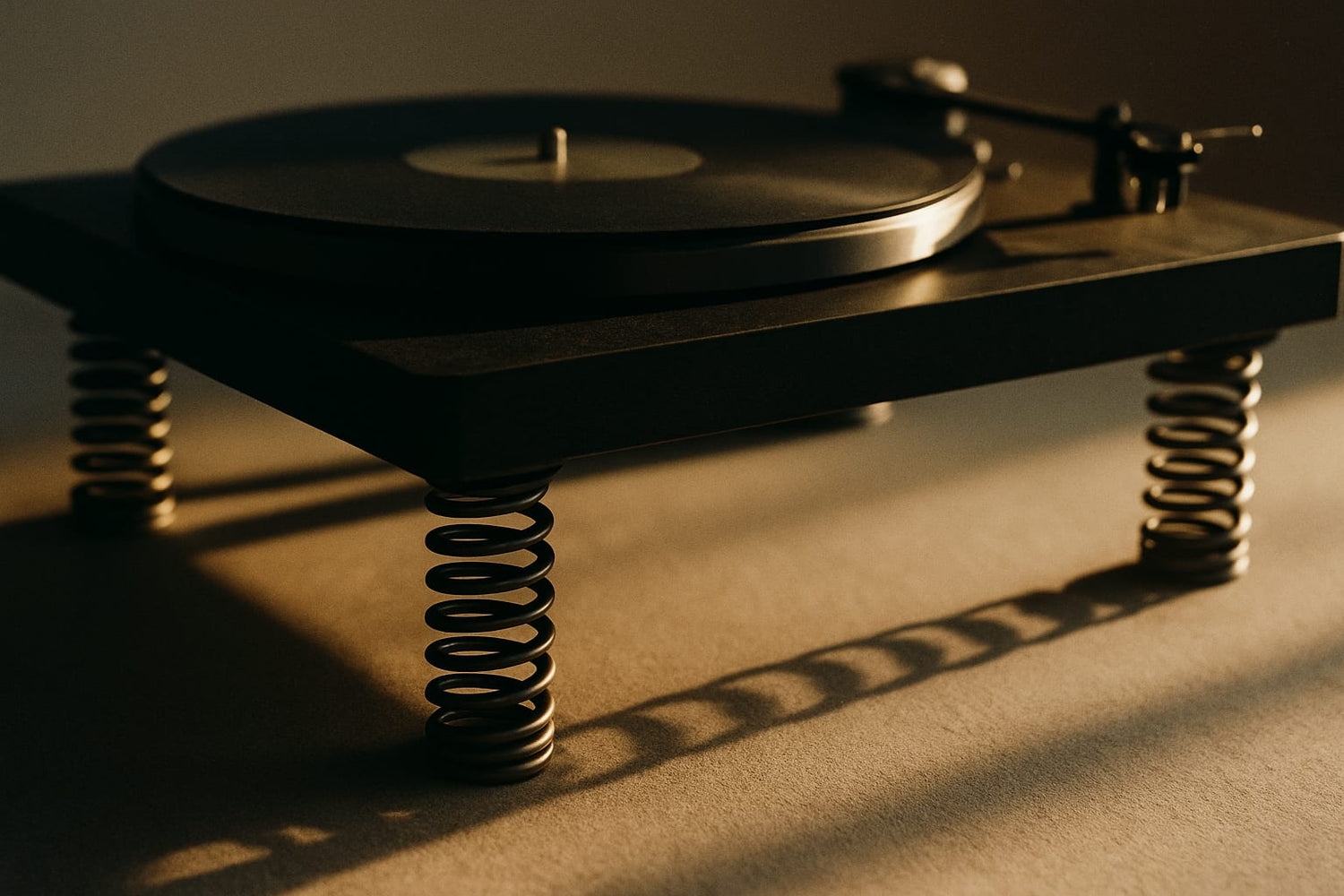
- ISOTOP MSN 1 KTL steel springs
- AMC WireRope Type B, a round-rope isolator
- PGFUN TR0-25, a line-rope isolator
- The turntable's own factory-fitted feet
All six sat under the same lightweight turntable — under 10 kg — on a concrete floor. Excitation came from a Norsonic Nor277 tapping machine, a standard piece of vibroacoustic test equipment, run in 15-second bursts. PCB accelerometers (models 352C22, 288D01 and 356B18) captured the response at each measurement point, with an RME Fireface UFX handling data acquisition and a Chirp Z-Transform with Hanning windowing used for spectral analysis. Notably, the turntable was powered off throughout — a deliberate choice by the researchers, and one with real implications discussed below.
Springs came out on top — and by a wide margin
Across the calculated resonant frequencies, the steel springs sat lowest at 3.8 Hz, followed by the round-rope isolator at 4.3 Hz, then the line-rope isolator at 5.1 Hz and the elastomer stack at 5.2 Hz. But the more useful finding isn't the resonance number itself — it's what happened above it.
The springs delivered the most effective and most consistent attenuation of any configuration tested, with the strongest performance at the cartridge in roughly the 8–15 Hz and 32–64 Hz bands. That's a meaningfully broad footprint, spanning both low-frequency structural motion and higher-frequency content closer to where audible-adjacent mechanical noise tends to live.
The elastomer stack told a more mixed story. It was effective in the 17–32 Hz range but actually amplified vibration around 56 Hz — a reminder that isolation materials don't uniformly suppress vibration across the spectrum; they can shift energy rather than simply remove it.
The line-rope isolator had its own bright spot, achieving the greatest damping at the platter across a 40–72 Hz range. But one of the two rope-based designs performed poorly overall: it increased vibration at the cartridge across most of the measured range, making it the clear underperformer of the six.
As for the factory-fitted feet that ship with the turntable — the ones most owners never think to replace — the study found they provided little useful isolation at all.
The spec-sheet problem
Perhaps the most practically important finding has nothing to do with which product won. It's that published stiffness specifications for the isolation materials failed to predict how they actually performed once installed and measured. The calculated resonant frequencies for all four non-baseline supports fell in a fairly tight 3.8–5.2 Hz band, which on paper might suggest similar behavior. In practice, effective attenuation didn't actually appear until roughly 10 Hz — well above where the on-paper resonance numbers alone would lead you to expect a payoff — and the measured differences between the four candidate supports were substantial.
In other words, a stiffness number on a data sheet is not a reliable stand-in for real-world isolation performance. You cannot infer, from spec figures alone, how a spring or an elastomer stack or a rope isolator will behave once it's under load and vibrating in a real system. Sawczuk and Chojnacki's conclusion is that low-frequency isolation in lightweight turntable systems (again, under 10 kg) is achievable — but it depends on proper material selection paired with actual vibration analysis, not on reading a stiffness rating and assuming it will translate.
What this study does not show
It's worth being precise about the boundaries here, because they're easy to blur. The turntable was powered off for every measurement, so motor rotation and stylus-tracking forces — real vibration sources during actual playback — were excluded from the test entirely; the authors acknowledge this themselves. Only vertical vibration was measured; horizontal or lateral excitation wasn't part of the protocol. Acoustic feedback from loudspeakers, a common real-world contributor to turntable vibration, wasn't tested either. And the entire study used a single turntable under 10 kg on a concrete floor — nothing here speaks to heavier, mass-loaded decks, or to performance on a suspended timber floor rather than concrete.
It's also worth stressing what the paper does not claim: there is no listening test anywhere in it. Nothing here says any of these support configurations sound better, worse, or different from one another. This is a vibration-measurement study, full stop, and the honest way to read it is as exactly that — a rare, carefully instrumented look at what happens mechanically underneath a lightweight turntable, not a verdict on what anyone would actually hear.
Within those limits, though, the data is genuinely useful. It's a reminder that isolation hardware behaves in frequency-dependent, sometimes counterintuitive ways, that off-the-shelf stiffness numbers don't tell the whole story, and that the feet a turntable ships with are not necessarily doing much isolating at all.
This article was written by an AI system from Into The HiFi AI Desk, generated from the following sources, with no human editing pass before publication: Sawczuk & Chojnacki, "Mitigation of Structural Vibrations in Sensitive Audio Devices: A Study on Isolation Materials for Lightweight Turntables," Materials (Basel), 2025, vol. 18, issue 11, article 2617 — open-access full text, DOI: 10.3390/ma18112617, Headphonesty, July 2026, "The First Ever Turntable Vibration Study Tested 6 Supports, and One Popular Setup Flopped Fast".


Leave a comment
This site is protected by hCaptcha and the hCaptcha Privacy Policy and Terms of Service apply.