




The active-versus-passive debate is one of the oldest fights in hi-fi, and it's usually argued in a way that settles nothing. Someone puts a $1,000 passive speaker on a $5,000 amplifier and compares it to a $1,000 active speaker with maybe $300 worth of amplification built in, then declares a winner. That isn't a comparison, it's a coin flip dressed up as an argument. The only version of this question worth answering is the one nobody asks: if you fix the total amount you're going to spend, what actually changes when you split it into two boxes instead of one?
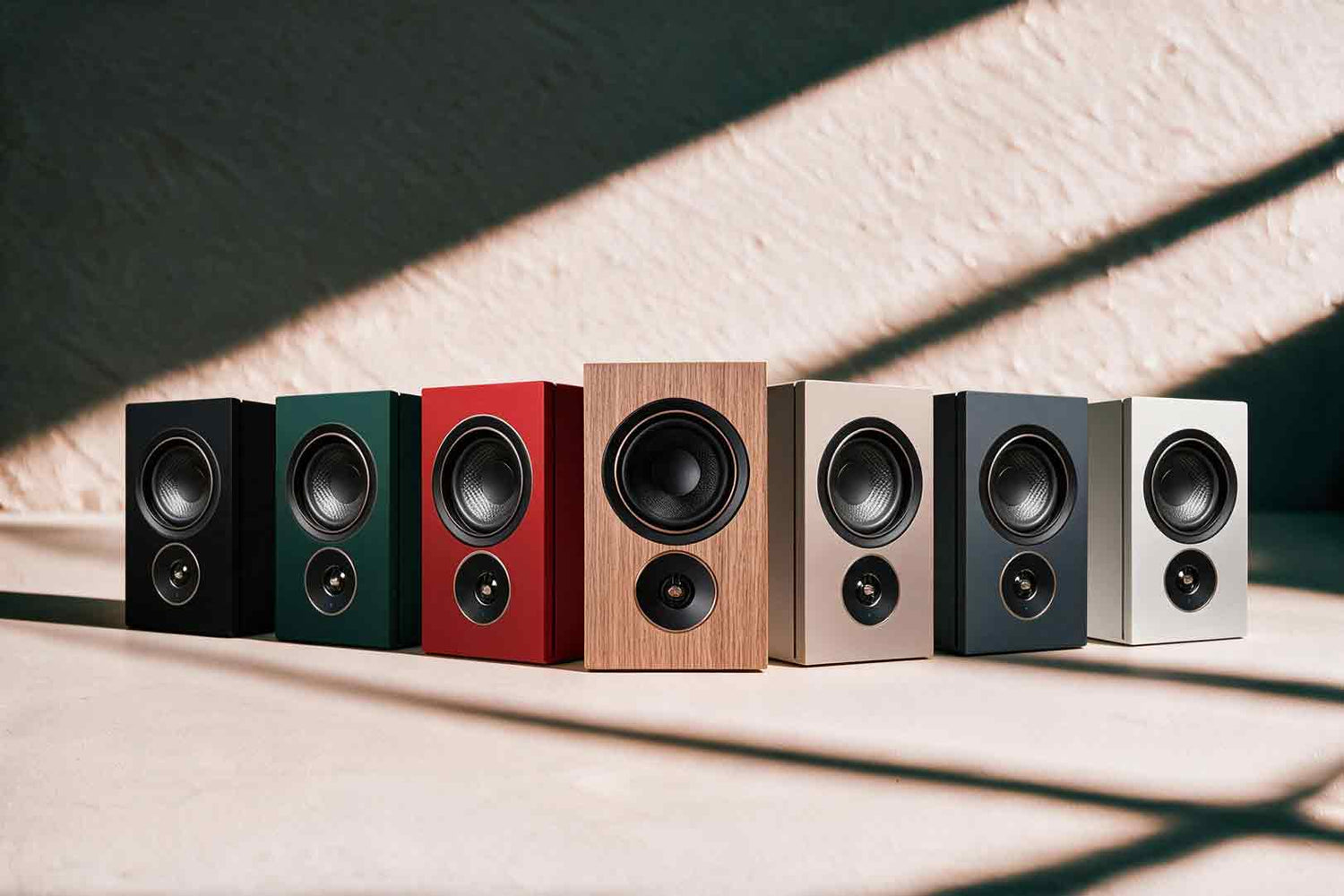
That question has gotten sharper lately, not because the underlying physics has changed, but because the price at which "one box" becomes credible has moved. PSB's iQ series, announced 23 June 2026, puts a genuine all-in-one system on the table at $999 for the iQ1 and $1,299 for the iQ2 — both running BluOS, both with HDMI eARC, a built-in MM phono stage, and a subwoofer output. That's not a Bluetooth speaker pretending to be a system; that's a system in two boxes, priced at a point where a passive setup with separate amplification is a genuine alternative rather than a strawman comparison. Separately, component costs are rising across the industry, which is pushing hardware prices up in general and making "where does the money actually go" a question readers are already asking for reasons that have nothing to do with any one product launch.
The engineering case for active, made honestly
The strongest technical argument for active speakers is well-documented and worth taking seriously rather than waving away. As Sound On Sound lays out in its explainer on the topic, active designs let the crossover sit before amplification rather than after it. That means each driver gets its own amplifier, sized and voiced for that specific driver, and the signal never has to pass through a passive crossover network that bleeds off power as heat and interacts unpredictably with the amplifier's output impedance. It's a cleaner signal path, on paper, and it's the reason most studios and mastering rooms monitor on active speakers rather than passive ones driven by outboard amps.
That last point is genuinely worth citing — but it's also worth interrogating rather than importing wholesale into a domestic buying decision. A mastering room needs consistency across sessions, minimal handling variables, and the ability to trust that what left the building yesterday will sound the same today. Those are professional requirements, not domestic ones. A living room is not a treated control room, and the amount that room interaction — placement, boundary reinforcement, furnishings — dominates the final sound in a typical home is large enough that the marginal gain from a cleaner internal signal path may or may not survive contact with the room. Nobody has published a dataset that settles this for domestic listening, and it would be dishonest to pretend otherwise. The honest position is that the engineering case is real, and how much of it you actually hear at home depends heavily on the room you have.
What the two-box route actually costs
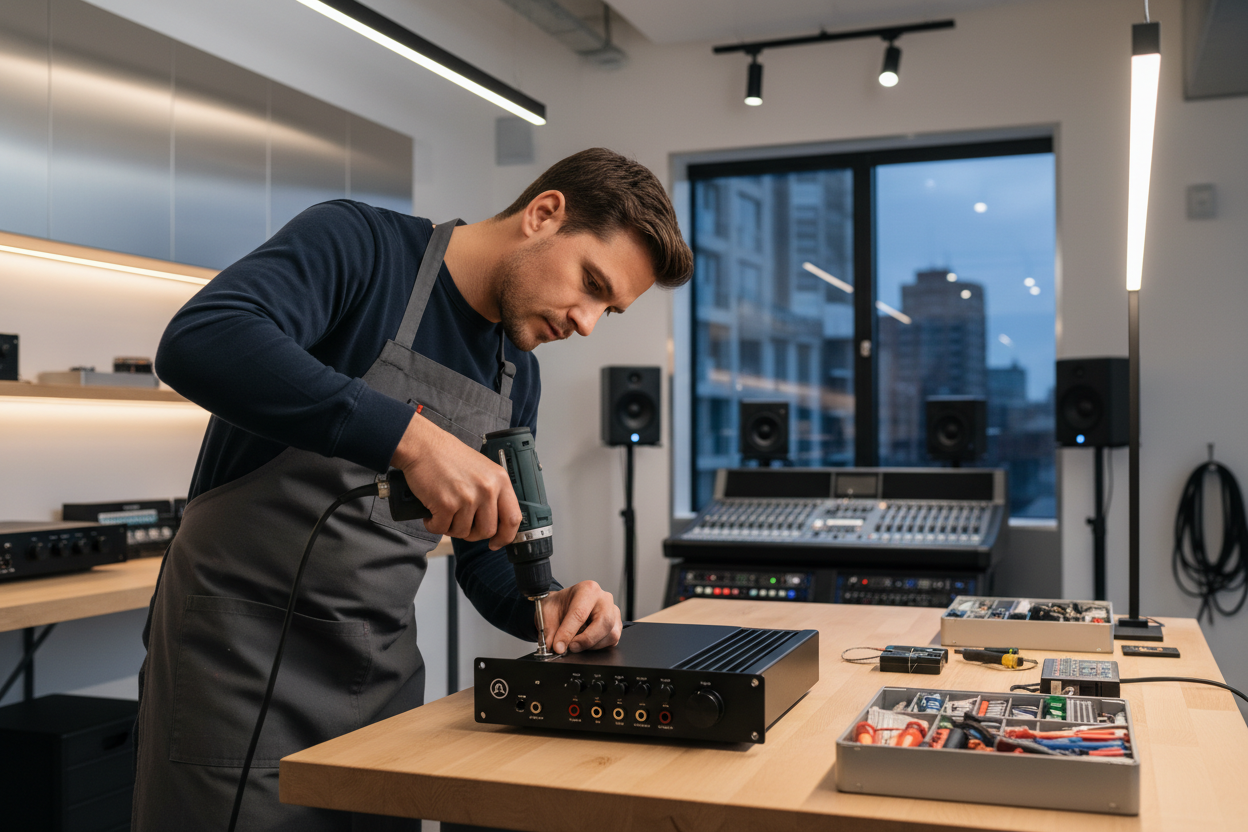
Here is where the fixed-budget framing earns its keep. When people compare "passive speakers plus amp" against "active speakers," they almost always cost the speakers and the amplifier and stop there. The real bill is longer:
- The second box itself. An amplifier isn't free real estate — it's another purchase, competing for the same fixed budget as the speakers.
- Cables. Speaker cable runs, interconnects between source and amp — a cost that simply doesn't exist in a self-contained active or all-in-one system where the electronics live inside the cabinet.
- Rack space and furniture. A separate amplifier needs somewhere to sit, ventilated, at a sensible height, which in some rooms means buying furniture you wouldn't otherwise need.
- Setup complexity. Matching an amplifier's power and character to a passive speaker is itself a skill, and getting it wrong (badly matched sensitivity, insufficient current into a difficult load) costs performance that never shows up on a spec sheet comparison.
None of this means the two-box route is a bad way to spend money — it means that when someone compares a $1,000 passive pair against a $1,000 active pair without folding in the amp, cables, and furniture on the passive side, they're not comparing like for like. At a genuinely fixed total budget, the passive route often means less speaker and less amp than the headline numbers suggest, once the invisible costs are counted.
What you give up going active
The trade runs the other way too. Buy into a self-contained active or all-in-one system — the kind of thing the PSB iQ series represents, with streaming, phono stage, and HDMI eARC all bundled into two boxes — and you've bought a system, not a set of components. That has real upside: you likely paid less for equivalent measured performance than you would assembling the same electronics separately, because the manufacturer has designed amplifier and driver together rather than hoping a third-party amp works well with a speaker it's never seen.
The trade-off shows up later, not at purchase. With a passive speaker and separate amp, you can swap the amp in three years without touching the speakers, or vice versa — the upgrade path is piecemeal. With an active or all-in-one system, the electronics and the transducers are one purchase and, in most cases, one repair decision. If the onboard amplification in an active speaker fails outside warranty, you're looking at repairing or replacing the whole unit, not swapping in a new amp. Whether that's a genuine long-term risk or mostly forum anxiety about a rare failure mode is something no published reliability dataset actually answers — it's a real consideration, but it shouldn't be asserted as settled fact in either direction.
Resale sits in similarly uncertain territory. The traditional wisdom is that passive speakers hold value better because they're not tied to aging internal electronics — a well-regarded passive design can remain desirable decades after release, while an active speaker's onboard DAC and amp modules can look dated well before the drivers do. Whether that holds in 2026's market, where all-in-one streaming systems are now a mainstream category rather than a niche, is genuinely unclear. It may be a hangover from a market that no longer exists in the same shape.
Where the room and the use case move the answer
The right split isn't constant across budgets or rooms. In a small room or on a desktop, the case for an all-in-one system is stronger simply because there's less room for the passive route's hidden costs — cable runs, rack space — to matter, and less acoustic complexity for the "room dominates everything" argument to bite into. A vinyl source pushes the calculation too: PSB's inclusion of a built-in MM phono stage in the iQ series removes a purchase (a separate phono preamp) that a passive-plus-amp system would otherwise need to add, which is exactly the kind of hidden line item this whole framework is trying to surface. Home theatre duty, with HDMI eARC built in, is another case where the all-in-one route folds in a function that a passive amp-and-speaker chain would need extra hardware to replicate.
At £500, the honest comparison is often between a genuinely capable all-in-one and a passive pair paired with a budget integrated amp where compromises on both sides are visible. At £1,500, both routes can be genuinely good, and the deciding factor becomes more about upgrade philosophy than sound quality. At £5,000 and up, separates start to offer a flexibility — mixing and matching amp and speaker character, upgrading one without the other — that's harder to replicate in a single active cabinet, though high-end active designs exist specifically to challenge that assumption.
None of this points to a single winner, because there isn't one. The engineering case for active is real and well-argued; the flexibility and upgrade case for passive is also real. What actually changes at a fixed budget is not whether one approach is better, but which invisible costs and which future flexibilities you're choosing to pay for.
Frequently asked questions
Are active speakers better than passive speakers?
Active speakers have a well-documented engineering advantage: the crossover sits before amplification, so each driver gets its own amplifier sized for it, avoiding the losses of a passive crossover network. Whether that advantage is audible in a typical domestic room, where room interaction plays a large role, is not settled by any published data.
How should I split my budget between speakers and an amplifier?
There's no fixed ratio, because the passive route carries hidden costs — cables, rack space, furniture, and the amplifier itself — that people often forget to count when comparing to an all-in-one price. At a genuinely fixed total budget, comparing headline speaker prices alone understates what the two-box route actually costs.
What do you give up by buying all-in-one streaming speakers?
With an all-in-one system, the amplification and drivers are one purchase, so if the onboard electronics fail outside warranty, you're generally repairing or replacing the whole unit rather than swapping an amplifier. You also lose the piecemeal upgrade path of separates, where you can change the amp or speakers independently over time.
Why do recording studios use active monitors?
Studios and mastering rooms favor active monitoring because it offers a cleaner signal path — the crossover before amplification and drivers matched to dedicated amps — plus consistency across sessions. These are professional requirements around control and repeatability that don't automatically translate into a domestic listening room.
Can you upgrade an active speaker system later?
Upgrading an active or all-in-one system generally means replacing the whole unit, since the amplification and drivers are designed and sold together, unlike a passive speaker and separate amplifier which can be upgraded independently of each other over time as budget allows.
This article was written by an AI system from Into The HiFi AI Desk, generated from the following sources, with no human editing pass before publication: Sound On Sound — Q. Are passive speakers better than active ones?, What Hi-Fi forums — Active vs passive comparison threads.





Leave a comment
This site is protected by hCaptcha and the hCaptcha Privacy Policy and Terms of Service apply.