Let the Kid In
Hi-fi has more great affordable gear than ever, and fewer young people hearing it. MoFi's Lenny Mayeux says the problem was never the gear. It's whether we let them in.
Written for The Sunday Listen · No. 01 By Lenny Mayeux
MoFi Distribution

When I was 12, I was walking through a little mall in Lake Charles, Louisiana, with my parents, and a man came up to me. "Lenny, are you coming to my house? I got a new Magnum Dynalab tuner." I told him I would, right after I went to hear Bob's new turntable. My dad looked at me and said, "Why are you calling a federal judge Bob and a cardiologist John?"
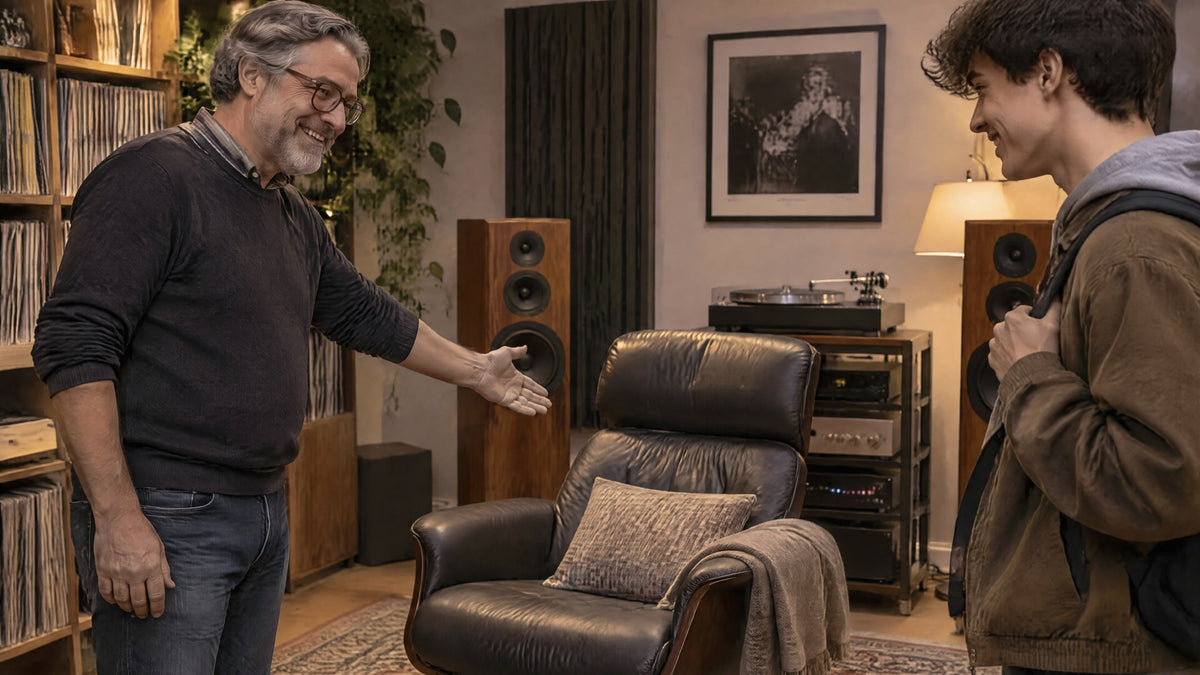
I said, "I don't know what they do for a living. They just got cool stereos." I'd found out who in town had the great systems. There were about a dozen of them, and I rode my bike to every one of their houses. Only two said I couldn't come in. The rest let a kid sit in their listening rooms. They made me mix tapes. They gave me old equipment. They talked to me.

I've been in this business professionally for 32 years. I've owned a shop, built speakers, and built million-dollar systems for rock stars. Today I'm the National Specialty Audio Manager at MoFi Distribution, and I spend my days on the road with dealers. Here is what I believe after all of it.
Hi-fi doesn't have a gear problem. We have more gear to satisfy the young music lover than we've ever had before. We just aren't putting the music lover in front of that gear. Somewhere along the way, we stopped doing what Bob and John did. We stopped letting the kid in.
Every door was open
In the seventies and eighties it was very common to have hi-fi stores next to universities. My father was a college professor, so I hung around campus. When I was about nine, I walked off campus and into Classic Audio, a Goldmund, Vandersteen and Nakamichi dealer. I'd touch everything, and the owner, Allen, would kick me out. Then I figured out the speaker selector. One day I snuck in to listen to music and ended up selling a pair of speakers for him. People thought I was his son. After that, he let me hang out.
The moment that really got me happened at a stranger's house. My older brother was babysitting me, got called into work, and dropped me off with his friend Stuart Babin. Stuart had no idea what to do with a kid, so he said, "Hey man, you want to listen to music?" He had a Luxman turntable, and he put on Thin Lizzy's "Cowboy Song." When he dropped the needle, it washed over me, and my life changed.
There was one more door, and I didn't understand how important it was until much later. My first job was bagging groceries at the Kroger in Lake Charles. The store had a magazine rack, and on that rack were four levels of hi-fi magazine. Stereo Review, with Julian Hirsch, reviewed gear at about $800 and below, and he was so in depth you could get absorbed by it. Audio went up to about $5,000. Then there were Stereophile and The Absolute Sound. I could be inspired by gear, and learn about gear, that cost 200 bucks. Every level of this hobby had a way in. A shop owner who let me stay. A dozen strangers who opened their homes. A guy who put on a record for a bored kid. A magazine I could afford to read about gear I could afford to buy.
Then we closed them
Go to a newsstand now. It's just Stereophile and The Absolute Sound. If you're a 15-yearold kid buying groceries, you look at that and think you need to be a millionaire to buy this stuff. It's completely out of reach. It used to not be.
When I had my store, a lot of people would come in around 50 years old and say, "I need a new system. I got my first one in college." Because hi-fi was cool. It separated you. In America, somewhere along the way, it became a status symbol for rich people instead of what it was in the seventies and eighties, which was about music enthusiasts. It became more like a Birkin bag than hi-fi. I've built million-dollar systems for rock stars, and for them it's an appliance, like a blender. "Cool, man, thanks."
Now picture a young person who actually shows up. You buy a ticket to an audio show, and it's room after room, each one more expensive. Power cords for $8,000. It's like looking for your first car and walking into a Ferrari dealership.
Or they walk into a shop. There aren't a lot of great hi-fi shops left, and the ones that are left are selling super-dollar gear or custom install. They don't have time to talk to some 19year-old kid who wants to talk about a pair of $500 speakers. I understand. If you've got a mortgage and rent on your shop, you've got a nut to crack. A lot of retailers are scared to put affordable gear on the floor because no young people are coming in, and it's an investment that doesn't sell. But it doesn't help us grow the industry.
And then there's the attitude. You know the caricature of the snobby waiter? He's not the one eating the expensive food. So why is he being snobby to the people who are? Somebody walks in and gets, "You don't know what a Western Electric 300B is?" No, they don't. And neither did you, until somebody told you.
It was never meant to be this way. If Richard Wagner were alive today, he'd be a heavy metal dude. Read the history. Those composers were sleeping with each other's wives, they were addicts, they were dying of syphilis. They were rock stars. Now we put on tuxedos to listen to their music. We've done the same thing to hi-fi.
What they're missing
Why does any of this matter? Because of what a good system gives you. To me, a hi-fi system is really two things.
It's a museum. Miles Davis is gone. All we have left is his art, and his art is music. You can have the greatest art book in the world, with the greatest photographs, and you still don't understand scale. The Mona Lisa is little and Salvador Dalí's paintings are enormous, but in that book they're the same size. When I play Miles, I'm hanging his art between those two speakers. The speakers disappear, and what's in the middle is his art. The better the system, the more color, dynamics and scale it has, the closer you get to the musicians we don't have anymore.
And it's a time machine. I was listening to Journey, "Separate Ways," late one night, and it took me back to an eighth-grade dance at Our Lady Queen of Heaven. I could smell the girl's perfume. I remembered the bad smoke machine. It's Proust and his madeleine: one bite and everything comes rushing back. The other day a song by The Cure reminded me it was playing the first time I kissed a girl. I hadn't thought about that in years. Music is memory. Music is medicinal. I have a bad day, and it puts me in a good mood.
The gear holds memories too. The rack my system sits on is the very first one Grand Prix Audio ever made. It was prototyped in my store, by a customer of mine who was burned out building race cars, and I'm the one who told him, "You know carbon fiber. Make carbon fiber." My Audiopax preamp was custom made for me by Eduardo de Lima, who is no longer with us. They say you die twice: once when they put you in the ground, and the last time somebody says your name. Every time I listen, I keep my friends alive. My system isn't just something I judge by its sound. It's a yearbook.
That's what's waiting on the other side of the door. That's what a kid never finds if nobody lets them in.
Open the door again
It starts with how we treat people. Folks recognize me from YouTube sometimes. "Hey, you're Lenny, right? You got a rig?" Yeah. "What do you have?" And they look down in shame. I tell them, no, don't do that. Look me in the face and tell me what you've got. Do you listen to it? Do you love it? Then that's the best system.
I don't like the word high-end, because high-end means money. You can have high-end pens, high-end shoes, high-end apartments. Hi-fi doesn't say expensive. A $199 pair of speakers is hi-fi to me. If you love your Bluesound, meaning you listen to it every day and can't wait to get home to your rig, I don't care what it cost. That's hi-fi. Once someone feels comfortable, the questions come, and we step up one piece at a time: a good used turntable, then a cartridge, then a phono cable, then a phono stage. I'm not shoving it down their throat. If someone's standing in front of me with a love of music, they're just as important to me as somebody spending $2 million.
Then we have to go where they are. Young people aren't going to walk into a hi-fi store. They're not going to go to an audio show. So I find out where people gather, and I go. I spin records at the Soho House in Beverly Hills with my friend Charles White, two Technics turntables and bins of records. People write down what they want, we play it, they dance around, and then they come up and ask, "I want this at my house. How do I get that?" I don't even talk about hi-fi. Everybody likes music, so I start with the music.
I want to do a food truck, but instead of food, two turntables and a rig. Pop-up hi-fi. I want to take gamers out of their headphones. Their gaming is communal but isolated, one guy in Alaska, one in Switzerland, one in Brooklyn. Put a great pair of speakers on that gaming system and invite your friends over. If you want to hear Grand Theft Auto and a V8, put it on a good system. The music will come after. Before the pandemic I was borrowing gear to start a hi-fi club at a school of the arts, like the photography and chess clubs. Give anybody under 20 a free ticket to the show. Dealers, keep a list of young buyers, and when a great receiver gets traded in, call them.
On a flight once, a young guy near me was talking about music, and he mentioned Rush. I happened to have a MoFi Rush record with me, so I showed him. He was studying electrical engineering at the University of San Diego. He went to the show in Costa Mesa and bought himself a turntable. He would never have done that unless somebody took the time to talk to him.
They're out there. I've played my system for my postman, my UPS guy, everybody. And they love it.
A hidden heyday
I'm not against the big stuff. I love that people push electronics to a ridiculous level to get a little more musical information. If the theoretical limit for a race car is 200 miles an hour and somebody builds one that goes 201, people will pay every penny on earth for that one extra mile an hour, because you get the checkered flag. That little bit better gets you a little closer to magic, and music is magic.
But the top of the market was never the problem. The bottom rung is where people come in, and right now that rung is the best it has ever been. We are living in a hidden heyday of hi-fi. Some of the greatest affordable gear ever made is out there: integrated amplifiers under a thousand dollars that are really phenomenal, speakers for a couple hundred bucks that I'm proud to call hi-fi. Start there. If it gives you the bug, if it makes you listen to more music, and more music, and more music, it will solve itself. Eventually you'll buy something better.
The gear is ready. The question is whether we are. There are young people out there willing to spend money and willing to love this, but first we have to love the customer. Right now we don't love the 19-year-old who comes in asking questions.
We need to. Bob and John didn't ask a nine-year-old on a bike what he could afford. They let him in, and he never left. We need to love them to make them love what we do.
When I was 12, I was walking through a little mall in Lake Charles, Louisiana, with my parents, and a man came up to me. "Lenny, are you coming to my house? I got a new Magnum Dynalab tuner." I told him I would, right after I went to hear Bob's new turntable. My dad looked at me and said, "Why are you calling a federal judge Bob and a cardiologist John?"
I said, "I don't know what they do for a living. They just got cool stereos." I'd found out who in town had the great systems. There were about a dozen of them, and I rode my bike to every one of their houses. Only two said I couldn't come in. The rest let a kid sit in their listening rooms. They made me mix tapes. They gave me old equipment. They talked to me.
I've been in this business professionally for 32 years. I've owned a shop, built speakers, and built million-dollar systems for rock stars. Today I'm the National Specialty Audio Manager at MoFi Distribution, and I spend my days on the road with dealers. Here is what I believe after all of it.
Hi-fi doesn't have a gear problem. We have more gear to satisfy the young music lover than we've ever had before. We just aren't putting the music lover in front of that gear. Somewhere along the way, we stopped doing what Bob and John did. We stopped letting the kid in.
Every door was open
In the seventies and eighties it was very common to have hi-fi stores next to universities. My father was a college professor, so I hung around campus. When I was about nine, I walked off campus and into Classic Audio, a Goldmund, Vandersteen and Nakamichi dealer. I'd touch everything, and the owner, Allen, would kick me out. Then I figured out the speaker selector. One day I snuck in to listen to music and ended up selling a pair of speakers for him. People thought I was his son. After that, he let me hang out.
The moment that really got me happened at a stranger's house. My older brother was babysitting me, got called into work, and dropped me off with his friend Stuart Babin. Stuart had no idea what to do with a kid, so he said, "Hey man, you want to listen to music?" He had a Luxman turntable, and he put on Thin Lizzy's "Cowboy Song." When he dropped the needle, it washed over me, and my life changed.
This is the opening of the story. The full version runs 9 minutes.
Talk about it
1 comment-
Lenny, It was great meeting you at CAF. Your energy, enthusiasm and love of music for all is what the world needs now! Great post and perspective.