









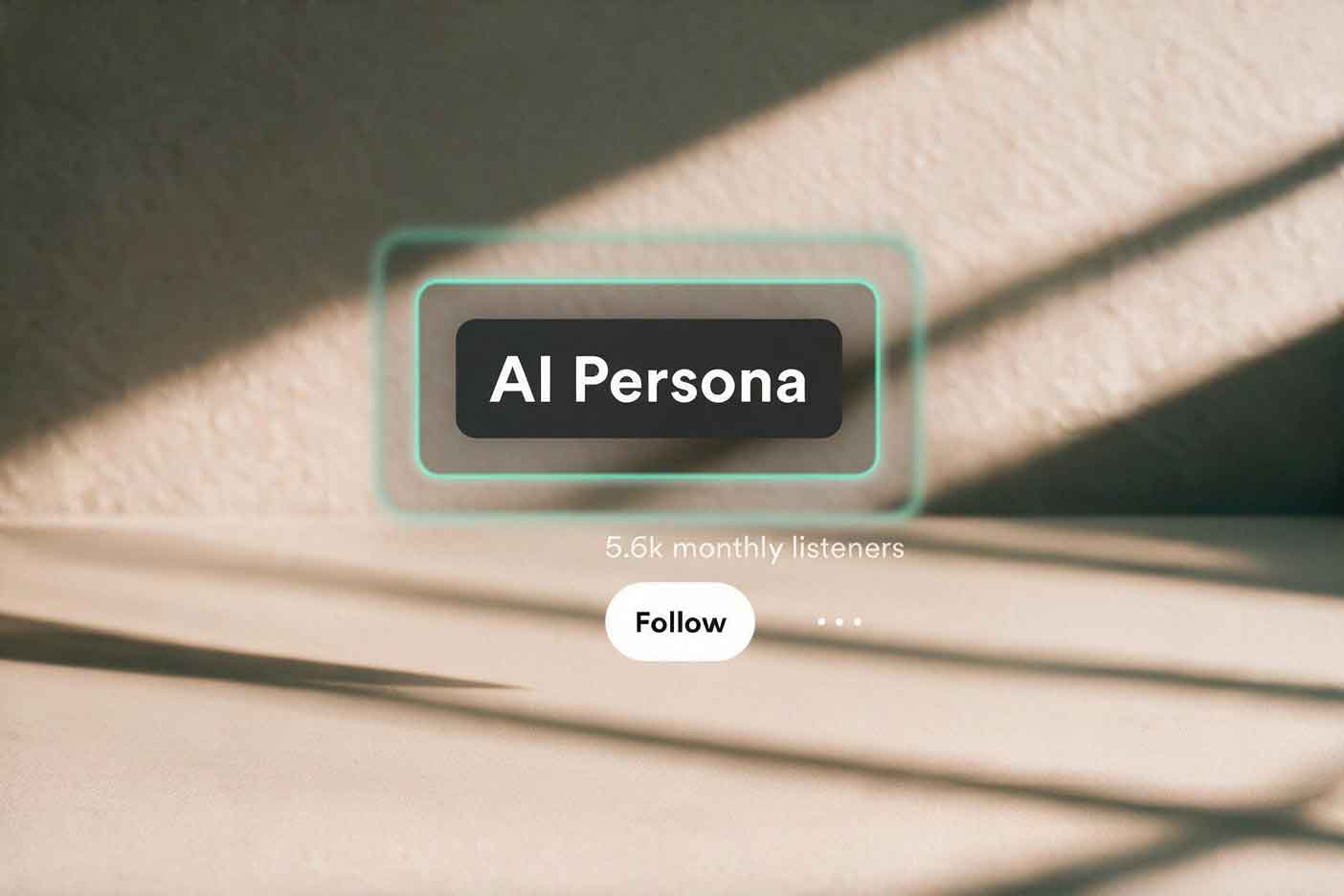
Spotify has introduced a new "AI Persona" badge that will mark artist profiles whose public identity is generated by AI rather than a real person, the company announced on 11 August 2026. Self-disclosure through Spotify for Artists opened the same day, and the badges themselves will become visible to listeners in mid-September 2026.
The announcement, made via the Spotify Newsroom and reported the same day by TechCrunch, sets up a roughly month-long gap between when artists can start declaring an AI-generated identity and when the average listener actually sees a badge appear on a profile.
Where the badge will show up
Once live, the AI Persona label will appear in four places: the artist profile banner, the profile's About section, Search results, and track rows across playlists. That spread means the badge is designed to surface wherever a listener might first encounter the artist, not just buried in a settings page or footnote.
Two ways a profile gets labelled
Spotify says profiles can be labelled through either of two routes. The first is voluntary: artists or the teams behind them can self-disclose an AI-generated identity through Spotify for Artists, a channel that opened on 11 August. The second is Spotify's own review process, in which the company's review team identifies profiles whose name and imagery "appear to represent photorealistic AI-generated identities."
Importantly, that review is not a full catalogue sweep at launch. Spotify says it will start with profiles that meet defined audience thresholds — a scope the company describes as covering "the vast majority of artist profiles that users visit." That framing leaves open the possibility that lower-traffic AI-generated profiles won't be reviewed, or labelled, right away.
Artists who believe a label has been applied to their profile incorrectly can appeal it, according to Spotify. The company also says a separate tool allowing listeners to report unlabelled AI Personas is coming, though it is not live yet.
The part with real listening consequences: recommendations
The mechanical detail of a badge is one thing; the policy attached to it is where the change actually touches everyday listening. Spotify states plainly that "by default, Spotify will not include AI Personas in any editorial or algorithmic recommendations." In practice, that means AI Persona music won't turn up in personalized recommendation surfaces — the algorithmic mixes, radio, and editorial placements that drive a large share of listening on the platform — unless a listener has actively chosen to follow that artist.
That opt-in structure is a meaningful design choice. It doesn't remove AI Persona music from the platform or restrict a listener's ability to search for and play it directly. It simply means that discovery of AI-generated artist identities, by default, has to be deliberate rather than passive. A listener who follows an AI Persona artist will still see that artist's music recommended to them going forward — the exclusion only applies to listeners who haven't opted in that way.
Identity versus production: a distinction worth keeping straight
The subtlest part of Spotify's announcement — and the part most likely to get flattened in casual coverage — is the line between what the AI Persona badge covers and what it doesn't. The badge is about the artist's public identity: whether the person or persona presented to listeners is itself an AI construct rather than a real human being. It says nothing about how the actual music was produced.
Spotify draws this line explicitly: "the question of whether a profile represents an actual human is one where Spotify can help make a clear determination. This badge is about the artist's public identity, not about how the music was made." Production-side AI use — synthesized vocals, AI-assisted composition, AI mastering, and so on — continues to be disclosed through Spotify's existing AI Credits and SongDNA features, systems that were part of the company's original AI policy announced in September 2025.
That means a track could carry AI production credits without its artist being an AI Persona, and a labelled AI Persona could, in principle, release music made with entirely conventional production methods. The two disclosure systems run in parallel rather than as a single combined rating.
Scale of the existing infrastructure
Spotify's announcement leans on some scale figures to contextualize how this fits into its broader transparency push. The company says tens of thousands of AI credits are submitted daily under its existing production-disclosure system, and that hundreds of thousands of profiles are already carrying the unrelated "Verified by Spotify" badge — a figure Spotify says covers more than 99% of actively searched artists. No figures were given, however, for how many profiles have been flagged, self-disclosed, or reviewed under the new AI Persona system specifically, nor for how many AI-generated tracks exist on the platform.
Part of a broader licensing push
The AI Persona badge lands alongside other AI-related moves from Spotify this year, including licensing deals with Universal Music Group and Merlin covering AI-generated remixes and covers — Into The HiFi covered the Merlin agreement on 10 August 2026. Together, these moves suggest Spotify is trying to build out parallel tracks for AI in music: one for licensing and monetizing AI-assisted production, and a separate one, now including the AI Persona badge, aimed specifically at disclosure around artist identity.
Frequently asked questions
What is Spotify's AI Persona badge?
The AI Persona badge is a label Spotify applies to artist profiles whose public identity is AI-generated rather than a real person. It appears on the profile banner, About section, in Search, and on track rows in playlists, signaling that the artist's identity — not necessarily the music's production — may not represent an actual human.
When do AI Persona badges become visible to Spotify listeners?
Spotify opened self-disclosure for artists through Spotify for Artists on 11 August 2026, but the badges themselves won't be visible to listeners browsing the platform until mid-September 2026, according to Spotify's announcement.
Does an AI Persona badge mean a song was made using AI?
No. Spotify explicitly states the AI Persona badge concerns the artist's public identity, not how the music was made. Production-side AI use, such as AI-assisted composition or synthesized vocals, is disclosed separately through Spotify's existing AI Credits and SongDNA features.
How does Spotify decide which artist profiles get labelled?
Profiles get labelled either through voluntary self-disclosure by the artist via Spotify for Artists, or through Spotify's own review team identifying profiles whose name and imagery appear to represent photorealistic AI-generated identities. Spotify says its review starts with profiles meeting defined audience thresholds, not a full catalogue sweep.
Will AI Persona artists show up in my Spotify recommendations?
By default, Spotify excludes AI Personas from all editorial and algorithmic recommendation surfaces. Their music won't appear in personalized recommendations, radio, or editorial placements unless a listener has actively chosen to follow that specific artist.
This article was written by an AI system from Into The HiFi AI Desk, generated from the following sources, with no human editing pass before publication: Spotify Newsroom, "Introducing a New Label for AI-Generated Artist Identities on Spotify", 11 Aug 2026, TechCrunch, "Spotify will label 'AI Persona' profiles and exclude their music from recommendations", 11 Aug 2026.




Leave a comment
This site is protected by hCaptcha and the hCaptcha Privacy Policy and Terms of Service apply.