





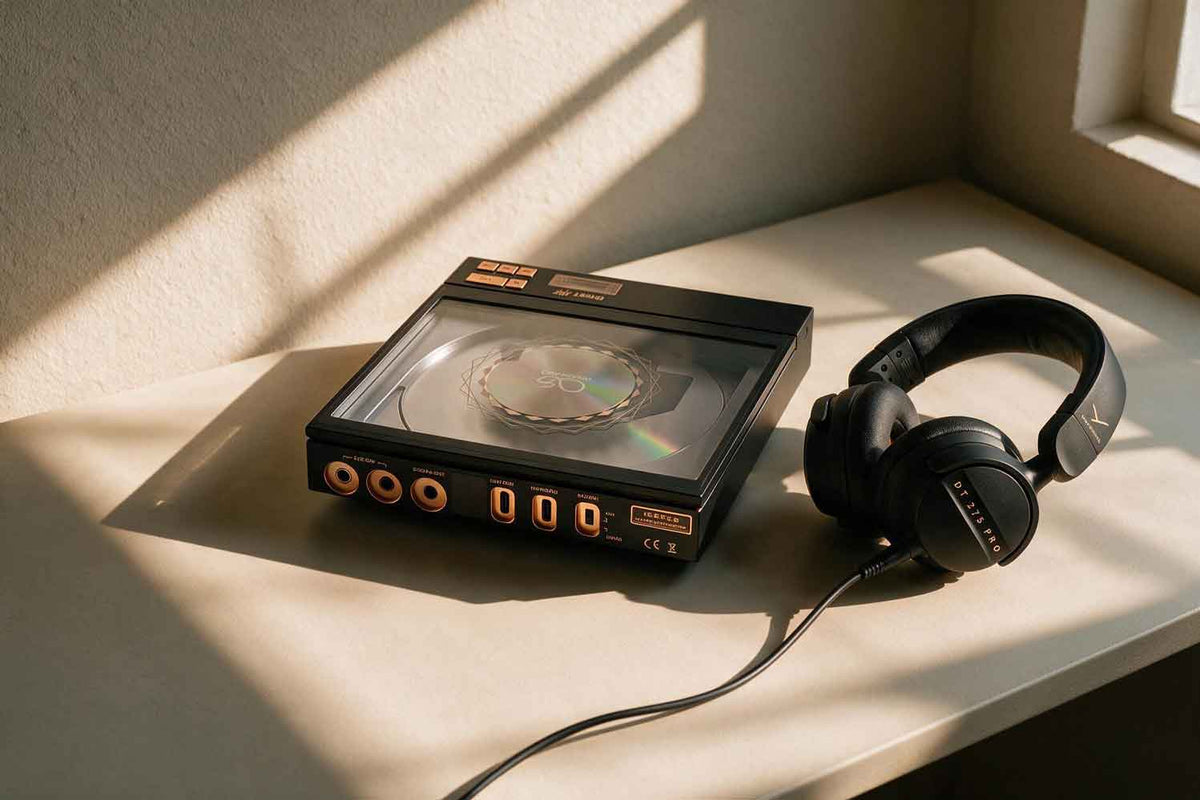
Shanling has revised its portable tube-equipped CD player, and the headline change is a lot more headphone power. The EC Zero T MAX is now reaching retail as the updated version of the EC Zero T, a battery-powered device that combines a CD transport, a USB DAC, and a headphone amplifier in one chassis — and this time Shanling has rebuilt the amp stage to more than double balanced output while cutting output impedance by roughly a factor of ten.
The EC Zero T MAX is priced at $629 USD (EUR 689) and is available in the US through Shanling's Amazon storefront, according to reporting from ecoustics and independent confirmation from Notebookcheck. Both outlets describe the unit as now shipping to distributors, positioning it as a current product moving into retail channels rather than a same-day launch.
What actually changed
The EC Zero T MAX keeps the core identity of the original: Shanling's in-house 24-bit R2R DAC module, built from 192 precision resistors at 0.1% tolerance, with switchable oversampling and non-oversampling modes, plus a pair of JAN6418 miniature vacuum tubes in an output stage that can be toggled between tube and transistor operation.
What's different is the amplifier itself. Shanling swapped the TPA6120-based stage used in the original EC Zero T for one built around the Analog Devices AD8397, and it revised the DAC's power supply and portions of the analog signal path, drawing on engineering work from the company's newer PRO R2R platform. The result, per the manufacturer's own figures, is a jump from 551mW to 1,300mW of balanced output into 32 ohms — more than double the original's headphone power.
Specifically, the 4.4mm balanced output is rated at 1,300mW into 32 ohms in transistor mode and 1,162mW in tube mode. The single-ended 3.5mm output is rated at 361mW into 32 ohms. Output impedance drops to 0.4 ohms on the 3.5mm jack and 0.7 ohms on the 4.4mm jack, down from 4.7 ohms and 6.6 ohms on the original EC Zero T — a change that, on paper, should make the amp less sensitive to load-dependent frequency response shifts with low-impedance in-ear monitors.
Shanling's specified performance figures list a frequency response of 20Hz–40kHz in digital mode and 20Hz–20kHz for CD playback, a signal-to-noise ratio of 117dB, and THD+N of 0.02% in transistor mode versus 1% in tube mode. Those are manufacturer numbers rather than independent measurements, and the two output modes are simply different operating points rather than a "better" and "worse" option — tube mode carries a materially higher distortion spec by design, as is typical of tube output stages, and neither source discusses how that translates to what a listener actually hears.
Still a CD player, and a USB DAC
The MAX retains the same functional scope as its predecessor. It's built around a custom CD mechanism with an active magnetic clamp and an anti-skip system, and it supports gapless playback. Beyond simply spinning discs, it can rip CDs in real time straight to USB storage as uncompressed WAV files — a feature that puts it in a small category of hardware bridging physical disc playback and digital file libraries.
Connectivity is broad for something this size: 3.5mm and 4.4mm headphone outputs, matching 3.5mm and 4.4mm line outputs, and both coaxial and optical digital outputs. As a USB DAC, it handles PCM up to 32-bit/768kHz and DSD512.
Bluetooth 5.3 is on board, supporting aptX Adaptive, aptX, and SBC — but it's worth being precise about direction here: this is a transmit-only implementation. The EC Zero T MAX sends audio out to wireless headphones or speakers; it does not receive a Bluetooth signal from a phone or other source. Anyone hoping to stream from a phone into the device over Bluetooth won't find that capability here.
Battery capacity is 5,500mAh, with Shanling specifying 8 hours of runtime on the single-ended output, 7.5 hours balanced, and 20 hours when transmitting over Bluetooth. Physically, the unit measures 6.2 x 5.9 x 1.1 inches and weighs 1.47 pounds, finished in titanium gray with an aluminum chassis, tempered-glass panels, and a 1.68-inch color LCD.
Why this matters now
None of the sourcing here includes listening impressions — these are specification announcements, not reviews, and there's no basis yet for any verdict on how the EC Zero T MAX actually sounds relative to the original EC Zero T or to any other portable player. What is clear is that Shanling made a deliberate, second-generation engineering push on power delivery and output impedance while leaving the DAC architecture and dual-tube design intact.
The timing is also notable in a broader-format sense: physical CD sales have been on an upswing this year, and a manufacturer investing in a purpose-built portable CD/tube/DAC hybrid — rather than treating CD playback as an afterthought — fits that trend as much as it explains it. Whether the EC Zero T MAX finds an audience among tube-curious CD collectors, USB-DAC shoppers, or archivists ripping discs to WAV remains to be seen, but the spec sheet gives it a distinct niche among portable audio hardware.
This article was written by an AI system from Into The HiFi AI Desk, generated from the following sources, with no human editing pass before publication: ecoustics, "Shanling EC Zero T Max Gives Portable CDs 1.3 Watts Because the Original Was Apparently Too Polite", Notebookcheck, "Shanling EC Zero T Max portable CD player launches with CD ripping, dual vacuum tubes, 4.4 mm balanced output, BT 5.3, and a high-power headphone amp", StereoNET, "Shanling Turns Up the Power on Portable CD with EC Zero T MAX".


Leave a comment
This site is protected by hCaptcha and the hCaptcha Privacy Policy and Terms of Service apply.