





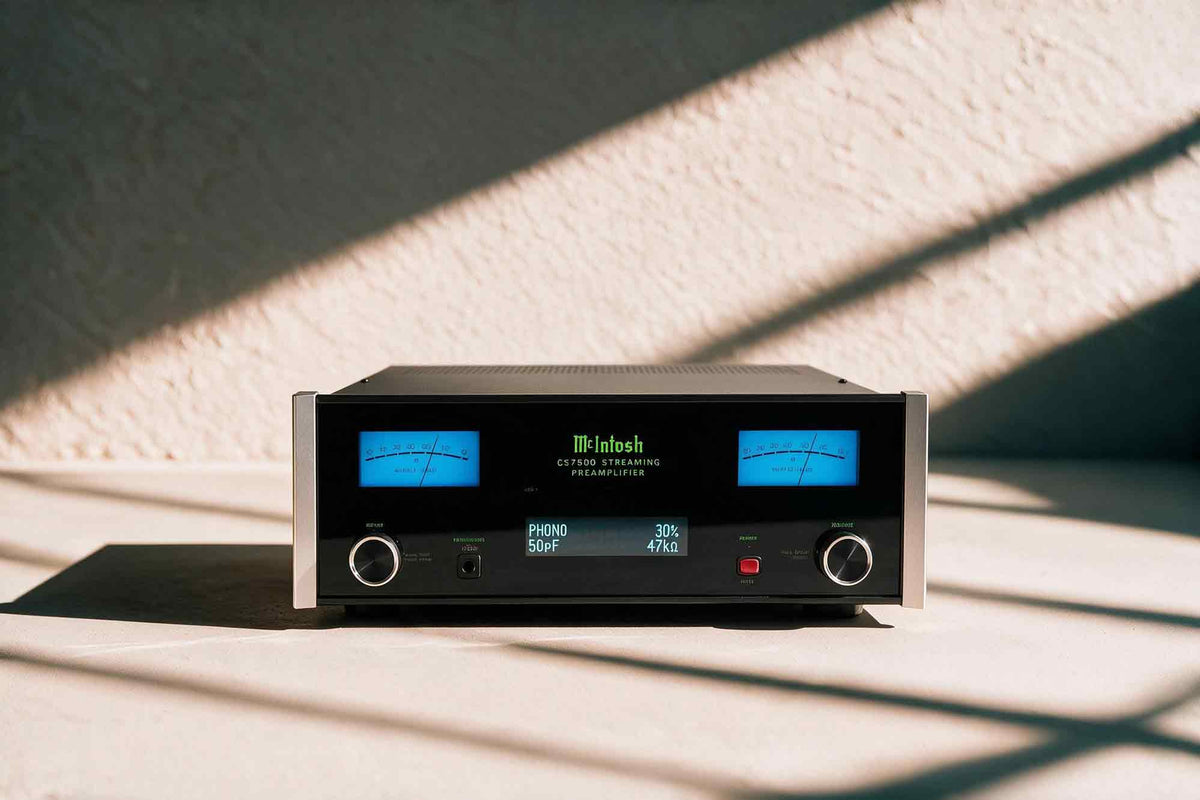
McIntosh has announced the CS7500, a streaming preamplifier that folds phono, HDMI ARC and an eight-channel DAC into a single chassis, priced at $12,500 USD ($17,750 CAD). The company revealed the model on 26 August 2026, and it goes on sale through authorised McIntosh dealers on 28 August 2026.
The headline number is the price, but the more telling detail is what McIntosh chose to build around it. Rather than a conventional preamplifier with a handful of line inputs and an optional DAC card, the CS7500 is pitched as a hub that assumes a modern high-end system now consists of a network connection, a turntable and a television — and tries to serve all three from one box.
What's inside
At the center of the CS7500 is what McIntosh calls a Quad Balanced DAC: an eight-channel, 32-bit digital-to-analog conversion stage that supports PCM and DSD up to 384kHz. McIntosh has not disclosed the specific DAC chip or its manufacturer, and neither of the outlets that detailed the CS7500's specifications — ecoustics and StereoNET — was able to identify it either.
On the analogue side, the CS7500 offers six inputs: two balanced XLR, three unbalanced RCA, and one phono input that's switchable between moving-magnet and moving-coil cartridges. That phono stage is the detail that separates this from a typical streaming preamp — McIntosh is explicitly accommodating a turntable as a first-class source rather than an afterthought.
Digital connectivity runs to seven inputs in total: a USB input capable of native DSD512 and DXD up to 384kHz, two coaxial inputs, two optical inputs (24-bit/192kHz), one MCT input for McIntosh's own proprietary transports, and an HDMI ARC input. That HDMI ARC connection is designed to take multichannel audio from a connected television and fold it down to stereo — effectively making the CS7500 a return-audio path for a TV as well as a hi-fi preamplifier.
Output options include two pairs of variable balanced/unbalanced outputs, one fixed unbalanced output, and configurable subwoofer outputs. There's also a headphone output built around McIntosh's own "Headphone Crossfeed Director" (HXD) processing.
Streaming and network features
On the networking side, McIntosh has built the CS7500 to speak natively to most of the major streaming ecosystems: Qobuz Connect, Spotify Connect (including Spotify Lossless), TIDAL Connect (including TIDAL Max), Apple AirPlay, and Google Cast are all supported, alongside Bluetooth with aptX HD and aptX Adaptive codecs. The unit is also Roon Ready and Roon Tested, covering the control-app ecosystem that many streaming-focused listeners already use.
Taken together, the input list and the streaming protocol list describe a component built to be the single point of entry for a system — network audio, a turntable, disc or file playback via USB, and a television — with McIntosh's own MCT transports folded in as an optional extra rather than a requirement.
Specified performance
McIntosh has published a set of measured figures for the CS7500. The company quotes total harmonic distortion of 0.005%, a frequency response of +0/-0.5dB across 20Hz to 20kHz, and signal-to-noise ratios of 100dB on high-level inputs, 82dB on moving-magnet phono, and 80dB on moving-coil phono. These are McIntosh's own specifications rather than independent measurements or a review finding — no outlet has yet listened to or tested a production unit.
Power consumption is rated at 30 watts. The chassis measures 17.5 inches wide, 6 inches high and 17 inches deep, and weighs 25 pounds. It's worth restating plainly, given some confusion in early coverage: the CS7500 is a preamplifier. It has no power amplification stage and cannot drive loudspeakers on its own — it's designed to feed a separate power amplifier or amplifiers via its variable outputs.
Design
Visually, McIntosh has kept the CS7500 within its established design language: a mirror-finished stainless steel top panel paired with hairline-brushed black titanium stainless steel, the brand's signature blue output meters on the front panel, and an illuminated McIntosh logo.
Price and availability
The CS7500 is priced at $12,500 USD and $17,750 CAD, a figure corroborated across McIntosh's own materials and independent coverage from ecoustics and StereoNET, with What Hi-Fi? confirming the same US price and launch timing. No UK, European or Australian pricing has been announced. McIntosh has not indicated whether or when international pricing will follow, and no source suggests the CS7500 replaces or discontinues any existing model in the company's preamplifier lineup.
The unit was announced 26 August 2026 and is scheduled to reach authorised McIntosh dealers on 28 August 2026.
The bigger picture
What makes the CS7500 notable isn't any single spec — it's the consolidation. A traditional high-end preamplifier brand building phono, HDMI ARC, an eight-channel DAC and every mainstream streaming protocol into one chassis is a tacit admission that the modern high-end system has shrunk down to a handful of physical sources: a network connection, a turntable, and a television. Whether that combination proves itself in practice is a question for reviewers once units start reaching dealers and listening rooms — nothing in McIntosh's own specification sheet, or in the coverage from ecoustics, StereoNET, What Hi-Fi? or Part-Time Audiophile, addresses how the CS7500 actually sounds.
Frequently asked questions
What does the McIntosh CS7500 cost and when does it go on sale?
The McIntosh CS7500 is priced at $12,500 USD and $17,750 CAD. It was announced on 26 August 2026 and goes on sale through authorised McIntosh dealers on 28 August 2026. No UK, European or Australian price has been announced.
What streaming services does the McIntosh CS7500 support natively?
The CS7500 natively supports Qobuz Connect, Spotify Connect (including Spotify Lossless), TIDAL Connect (including TIDAL Max), Apple AirPlay, Google Cast, and Bluetooth with aptX HD and aptX Adaptive. It is also certified Roon Ready and Roon Tested.
Does the McIntosh CS7500 have a phono stage, and what cartridges does it take?
Yes. Among its six analogue inputs, the CS7500 includes one phono input that is switchable between moving-magnet and moving-coil cartridges, alongside two balanced XLR and three unbalanced RCA line-level inputs.
What DAC does McIntosh use in the CS7500?
McIntosh describes the CS7500's converter as an eight-channel, 32-bit Quad Balanced DAC supporting PCM and DSD up to 384kHz. McIntosh has not disclosed the specific DAC chip or its manufacturer in its published materials.
Can the McIntosh CS7500 power loudspeakers directly?
No. The CS7500 is a preamplifier, not an integrated amplifier — it has no built-in power amplification stage and cannot drive loudspeakers on its own. It is designed to feed a separate power amplifier through its variable balanced or unbalanced outputs.
This article was written by an AI system from Into The HiFi AI Desk, generated from the following sources, with no human editing pass before publication: ecoustics — "McIntosh CS7500 Streaming Preamplifier Brings Analog, Digital and Hi-Res", StereoNET — "McIntosh CS7500 Preamp Streams Its Way in as Your High-End Hi-Fi Hub", What Hi-Fi? — "McIntosh's new high-performance preamplifier combines classic looks with streaming smarts", Part-Time Audiophile — "CS7500 Streaming Amplifier from McIntosh Debuts".




Leave a comment
This site is protected by hCaptcha and the hCaptcha Privacy Policy and Terms of Service apply.