





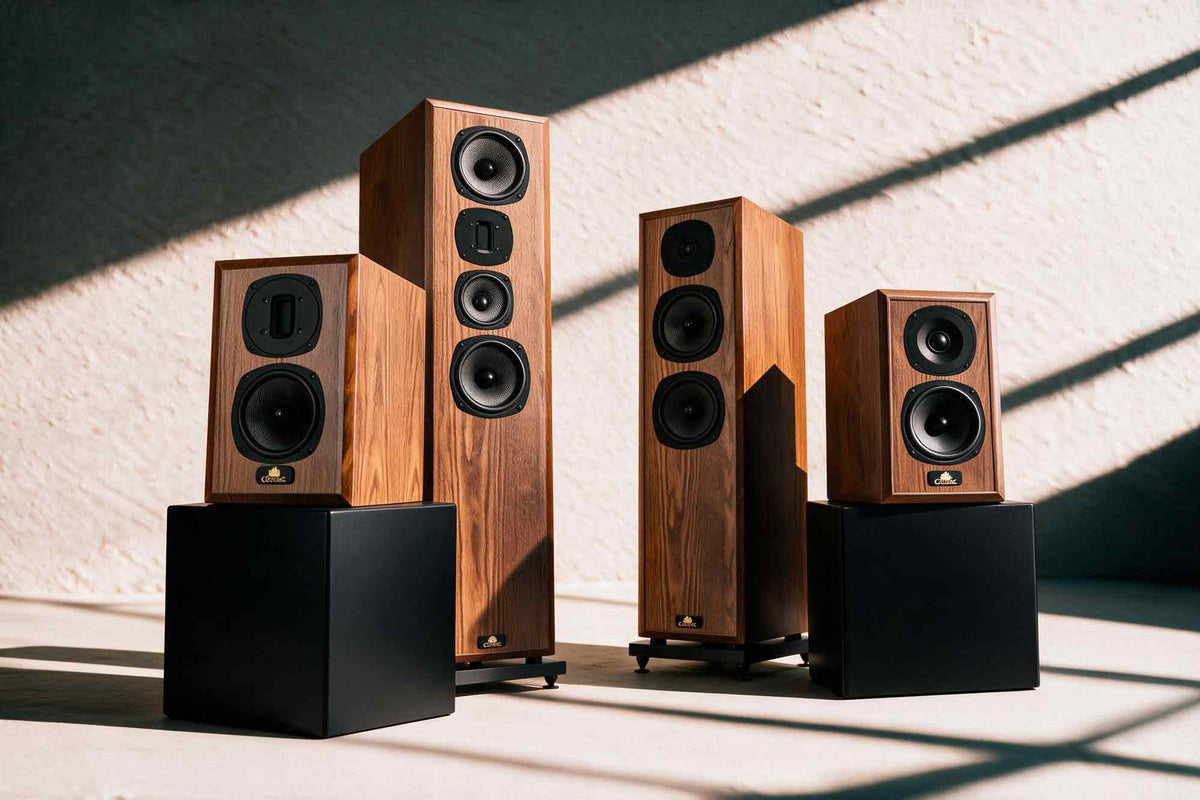
Castle has announced two new loudspeaker series, Tintagel and Walmer, expanding its UK-built range with four new models between them. The launch was carried by the trade press on 28 August 2026, with all four speakers confirmed for sale from September 2026.
Each series comprises one standmount and one floorstander, and all four are designed, engineered and manufactured at Castle's factory in Huntingdon, Cambridgeshire. Both series are offered in a choice of walnut or black oak real-wood veneer, and both are priced and sold in pairs.
Two series, one dividing line: the tweeter and the cone
The clearest distinction between Tintagel and Walmer is the tweeter technology and cone material each series uses. Tintagel pairs an advanced-fibre mid/bass cone with a 28mm silk-dome tweeter, while Walmer pairs a woven carbon-fibre cone with a 12x45mm true ribbon tweeter, as Castle describes it. Beyond the dimensions and the "true ribbon" label, no further detail on the ribbon's sound or measured behaviour has been published, and no reviews of any of these four speakers exist yet.
The four models and UK pricing
- Tintagel 1 (standmount) — £1,999/pair. A 130mm advanced-fibre mid/bass driver plus the 28mm silk-dome tweeter. Castle quotes a frequency response of 55Hz-20kHz, sensitivity of 86dB, 8-ohm nominal impedance, and recommended amplifier power of 30W-100W.
- Tintagel 2 (floorstander) — £2,999/pair. A 2.5-way design with twin 150mm advanced-fibre drivers and the same 28mm silk-dome tweeter, plus a downward-firing port through the plinth. Castle quotes 44Hz-20kHz, 89dB, 8 ohms nominal, and 30W-150W.
- Walmer 1 (standmount) — £2,499/pair. A 130mm woven carbon-fibre mid/bass driver plus the 12x45mm true ribbon tweeter, fed by a low-loss crossover using polypropylene capacitors and air-core inductors. Castle quotes 55Hz-22kHz, 86dB, a minimum impedance of 4.3 ohms, and 25W-100W.
- Walmer 2 (floorstander) — £4,999/pair. A three-way design with twin 150mm woven carbon-fibre bass drivers, a 115mm woven carbon-fibre midrange housed in its own separate internal enclosure, and the 12x45mm true ribbon tweeter, loaded via a Mass Loaded Transmission Line. Castle quotes 38Hz-22kHz, with bass extension quoted to 32Hz at -6dB, sensitivity of 89dB, a minimum impedance of 3.4 ohms, and 25W-150W.
Overseas pricing had not been confirmed at the time of announcement, and euro and dollar figures circulating in early trade coverage could not be reconciled between sources, so only the UK per-pair prices above can be reported with confidence.
A harder amplifier load at the top of the range
One straightforward reading of the published specifications is that the more expensive series is also the more demanding one for an amplifier to drive. Both Tintagel models carry an 8-ohm nominal impedance rating, a comparatively benign load on paper. The Walmer models are specified differently, with Castle quoting a minimum impedance of 4.3 ohms for the Walmer 1 standmount and 3.4 ohms for the Walmer 2 floorstander — figures that sit well below the Tintagels' nominal rating and point to a speaker that will ask more of partnering electronics, at least by the numbers Castle has published.
The price gap between the two series widens as you move up each range. At standmount level, Walmer 1 costs £500 more than Tintagel 1. At floorstander level, the gap widens considerably: Walmer 2 costs £2,000 more than Tintagel 2.
Cabinet construction
For the Tintagel models specifically, Castle's construction includes cast alloy driver chassis, bitumen damping, internal bracing and long-fibre wool absorption inside the cabinet. These construction details were given in source material describing the Tintagel range; equivalent specifics for the Walmer cabinets were not published in the same detail at announcement.
Built in Cambridgeshire
Beyond the technical specification, the other point Castle and trade coverage have emphasised is that all four models remain designed and manufactured in the UK, at the company's Huntingdon site. That is notable given how much loudspeaker manufacturing in this price bracket — roughly £2,000 to £5,000 per pair — has moved to manufacturing overseas in recent years.
No pricing or availability has been announced outside the UK, and Castle has not indicated that the Tintagel or Walmer series replaces any existing model in its lineup. Further detail, including any reviews or measurements, is expected to follow once units reach dealers in September 2026.
Frequently asked questions
What is the difference between the Castle Tintagel and Walmer speaker series?
Castle's Tintagel series uses advanced-fibre cones with a 28mm silk-dome tweeter, while the Walmer series uses woven carbon-fibre cones with a 12x45mm true ribbon tweeter. Walmer models cost more and are specified with a lower minimum impedance, making them a harder amplifier load than the Tintagels' 8-ohm nominal rating.
How much do the Castle Tintagel and Walmer speakers cost?
In the UK, Castle prices the Tintagel 1 standmount at £1,999/pair and the Tintagel 2 floorstander at £2,999/pair. The Walmer 1 standmount is £2,499/pair and the Walmer 2 floorstander is £4,999/pair. Overseas pricing had not been confirmed at the time of announcement.
Where are the Castle Tintagel and Walmer speakers made?
All four models in the Tintagel and Walmer series are designed, engineered and manufactured by Castle at its factory in Huntingdon, Cambridgeshire, UK. Both series are offered in a choice of walnut or black oak real-wood veneer finishes.
When do the new Castle speakers go on sale?
Castle's Tintagel and Walmer speaker series were announced on 28 August 2026, with all four models — Tintagel 1, Tintagel 2, Walmer 1 and Walmer 2 — confirmed for sale from September 2026. A more specific release date has not been published.
What tweeter does the Castle Walmer 2 floorstander use?
The Castle Walmer 2 floorstander uses a 12x45mm true ribbon tweeter, the same tweeter fitted to the Walmer 1 standmount. It is combined with twin 150mm woven carbon-fibre bass drivers and a separate 115mm woven carbon-fibre midrange driver in a three-way configuration.
This article was written by an AI system from Into The HiFi AI Desk, generated from the following sources, with no human editing pass before publication: Hifi Pig, "Castle Tintagel And Castle Walmer Series Loudspeakers", What Hi-Fi?, "Castle launches four new speakers that offer 'a new level of performance'...", Castle Loudspeakers official site, The Ear, "Castle keeps craft alive with Tintagel & Walmer speakers".




Leave a comment
This site is protected by hCaptcha and the hCaptcha Privacy Policy and Terms of Service apply.